Al Schneider's Rocky Mountains Plant Descriptions

White Fir
Abies concolor
Pine family (Pinaceae)

White Fir (Abies concolor) occurs primarily in southern Colorado and on into New Mexico. It is a handsome tree, which does, however, tend to become distorted with age. The sharply upward curving leaves are common. Leaves are pale blue-green, flat, and blunt-tipped. Philip Miller named this in the 18th century; "Abies" is the classical Latin name. The species was first collected for science by Augustus Fendler in his mid-1840s botanizing in New Mexico and the plant was first named Picea concolor by George Gordon and Robert Glendinning in 1858. It was renamed Abies concolor by Lindley in 1861, and, interestingly, it was given a third name in 1868 when the eminent botanist George Engelmann named it Pinus concolor.
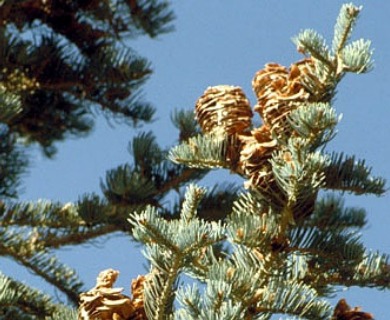

© Dave Powell, USDA Forest Service, Bugwood.org
Description

Tree to 100' tall with conic to rounded . Bark thick, smooth when young except for resin blisters, strongly furrowed and dark gray in age. Leaves solitary (not in bundles of multiple leaves), flat in -section, blue to yellow-green. ; male cones rose to dark red, to 3/4" long, female cones yellow-green to green-purple, erect 3 to 5" long, fan-shaped. Seeds broadly .

Field Marks

Tall tree with blue-green upward turned leaves.

© Al Schneider

An evergreen tree retains a large portion of its green leaves all year.

scale -- A very small leaf around a dormant bud. Also other things that might remind one of fish scales on the surface of ferns, stems and the like.

cross -- To make something interbreed. The act of hybridization.

canopy -- The foliage of a tree; the crown. Also the upper layer of a forest.

genus -- A subdivision of a botanical Family in which all members have a significant number of similar characteristics.

wing -- A maple seed has wings.

monoecious -- all flowers have both sexes; or both sexes in different flowers on the same plant.