Al Schneider's Rocky Mountains Plant Descriptions

Subalpine Fir
Abies lasiocarpa
Pine family (Pinaceae)

The branches of Fir often persist right to the ground, forming a skirt. This is the only true fir native to the region, and it generally occupies sites characterized by cold winters, cool summers, frequent summer frosts, and heavy snowpack. The lumber is used in prefabricated wood products and pulpwood. Small trees are extensively used for Christmas trees. Stands of Fir provide browse and cover for a wide range of wildlife species and the seeds are eaten by several species of small mammals and birds. Abies bifolia and A. lasiocarpa (a coastal states species) were once considered the same species but chemical and physical differences have led to their being consider separate species. "Abies" is the classical Latin name.
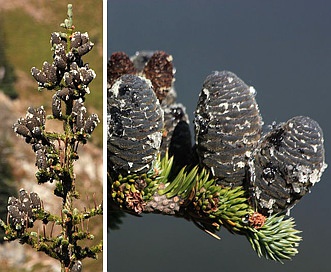

©2013 Walter Siegmund
Description

with slender, spire-like that sheds snow and reduces wind resistance. Seed cones are about 3.5" long and dark purple when mature. They grow on upper branches in an erect position on twigs. As cones mature, and seeds fall off, leaving an erect, woody -like cone axis. Needles are about 1" long, flexible, and flattened (won't roll between fingers). Tips are blunt. Needles arise from all sides of twigs and tend to grow upward.

Field Marks

Conifer with slender , upright cones, flattened needles.

© Al Schneider

An evergreen tree retains a large portion of its green leaves all year.

subalpine -- Just below the timberline.

scale -- A very small leaf around a dormant bud. Also other things that might remind one of fish scales on the surface of ferns, stems and the like.

canopy -- The foliage of a tree; the crown. Also the upper layer of a forest.

A spike is an unbranched, indeterminate inflorescence in which the flowers are without stalks.