Al Schneider's Rocky Mountains Plant Descriptions

Fragrant Snakeroot
Ageratina herbacea
Aster family (Asteraceae)

Fragrant Snakeweed (Ageratina herbacea) is a woody-based that can grow to 80 tall and to over a wide. Leaves are mainly , notched, from one to three inches long, and a pale yellow/green. Flowers are white, numerous, and showy. The flowers of Ageratina herbacea present a densely packed, swirling confusion of white. The filamentary projections are the which bear their pollen on the underside of the curved tips. About eight-to-twenty flowers are crowded into each head. There are no and the individual flowers are tubular, white (often with tinges of light red just above the ), and only about 1 1/2 millimeters wide. are nearly equal in length and usually in one inner and one outer row. Ageratina herbacea might be mistaken for a Brickellia, especially because of the similar and typical rocky habitat and triangular leaves. But a careful look, especially at the flowers, shows distinct differences.

In 1853 Asa Gray named this plant Eupatorium herbacea from specimens gathered in Mexico by Charles Wright when he participated in the Mexican Boundary Survey of 1851-1852. Edward Greene renamed the plant Ageratina herbacea in 1901. "Ageratina," a name given by Edouard Spach in 1841, is a diminutive of "Ageratum," a many of us know from our garden.


©2012 Keir Morse
Description

Plants , woody only in the (woody base of non-woody ). Stems from 1 to almost 3' tall, rather yellow-green, slightly hairy. about 1-2" long, to triangular, obscurely . about 1/3" long. crowded. about 1/8" long, bell-shaped, in 2 rows about equal in length. Flowers about 10-20/head, white or faintly purple tinged. an .

Field Marks

Small shrub-appearing plant with yellow green leaves and mass of numerous flowers.

© Al Schneider

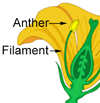
stamen -- the pollen-producing reproductive organ of a flower; The stamen consists of an anther supported by a filament.

A perennial plant lives and blooms for many years.

cm -- A centimeter which is about 0.4 inches.

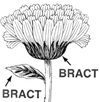
phyllaries -- Leaflike bracts covering the flowers before opening and remaining under the flower after it opens. Also called "bracts". Only used with the sunflower family (Asteraceae).

achene -- a type of simple dry fruit produced by many species of flowering plants. For example, a rose hip holds a few achenes.

disc flowers are those in the center of a sunflower or daisy. Not a ray flower.

ray flowers -- The outer petals of a sunflower or daisy are ray flowers.

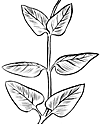
In an opposite leaf arrangement the leaves come in pairs with one leaf on each side of a stem.

Bracts are modified leaves associated with a flower.

m -- A meter is about 10% larger than a yard.

ovate -- Oval, egg-shaped, with a tapering point.

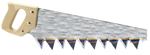
Like the teeth on a saw, leaves and other surfaces can have toothed edges.

fruit -- any seed-bearing structure in flowering plants. It is formed from the ovary after flowering.

In an opposite leaf arrangement the leaves come in pairs with one leaf on each side of a stem.

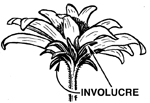
Involucre is the name given to the circle or spiral collection of bracts around a flower-cluster.

A herb is a plant whose stems die back to the ground in the winter.

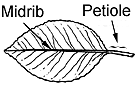
petiole -- the stalk of a leaf.

caudex -- The woody stem base of some herbaceous perennials.

genus -- A subdivision of a botanical Family in which all members have a significant number of similar characteristics.

An inflorescence is a group or cluster of flowers arranged on a stem.