Al Schneider's Rocky Mountains Plant Descriptions

Nodding Onion
Allium cernuum
Onion family (Amaryllidaceae)

The nodding bell-like flowers restrict insect visitors largely to bees as many other insects are reluctant to feed upside down. Nodding Onion is edible and commonly harvested. The plant is also cultivated in gardens. This Onion grows throughout the Rocky Mountain West. It is easily distinguished from other onion species by its nodding flowers, and this characteristic gives rise to its specific epithet, "cernuum," which means "nodding." Compare this species to the very similar Geyer's Onion Allium geyeri.
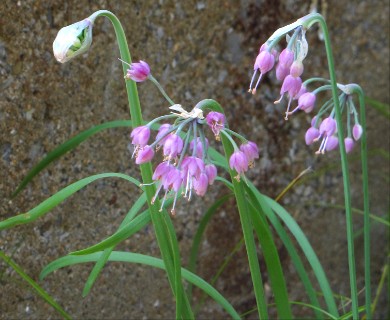

©2011 "BlueRidgeKitties"
Description

Upright with onion smell, 6-20" tall, growing from egg-shaped . consisting of 3-7 flat, grass-like . Smooth round flower stem curves downward (near its tip) supporting an of white-pink flowers. Bell-shaped flowers have 6 rounded and 6 yellow-tipped that extend beyond the petals.

Field Marks

White-pink nodding flowers with narrow, onion-flavored leaves.

© Al Schneider

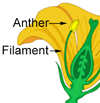
stamen -- the pollen-producing reproductive organ of a flower; The stamen consists of an anther supported by a filament.

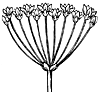
An umbel is a collection of flowers on short stalks which spread from a common point, somewhat like umbrella ribs. The arrangement can vary from being flat-topped to almost spherical.

A perennial plant lives and blooms for many years.

A herb is a plant whose stems die back to the ground in the winter.

basal -- at the base, situated or attached at the base.

basal leaves -- a leaf that grows lowest on the stem of a plant.

tepal -- like a flower petal. Tepal is used, instead of petal, when it is not easy to tell the sepals from the petals.

A bulb is an underground stem, the main body of which consists of thickened scales, which are in reality leaves or leaf bases, as in the onion.

blade -- Just the flat part of a leaf. Not the stem.