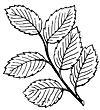
Like willows, alders are a pioneer species, capable of establishing themselves along riverbanks prone to flooding and other disturbance. Alder roots also fix nitrogen, allowing them to grow in poor soils. Gray Alder, also called Mountain Alder, is an attractive, low-growing shrub/tree common along streams. Its leaves are and often folded inward along the central leaf vein. "Alnus" is the ancient Latin name for the tree, and "" is Latin for "gray or hairy."
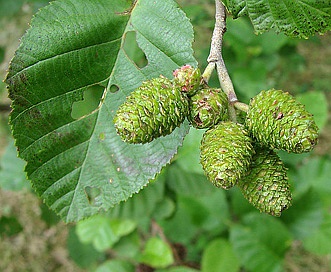
tree/shrub, 6-30' tall, often with numerous stems and with gray-brown to red bark. , broadly elliptical, rounded to at base and rounding to a pointed tip. Leaf margins strongly wavy-edged and double ; upper surface green hairless to soft hairy, underside paler and soft-hairy, especially along veins. Male and female flowers occur on same branch as , developing before leaves. Female are semi-woody, on short , which develop as the leaves are produced. Cones persist after seeds are shed. Male in slender hanging clusters.
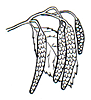
A catkin is a tight cylindrical flower cluster where flowers connect directly to a stem.
The flowers generally don't have petals and the stem is often drooping.
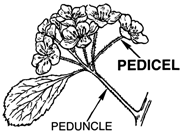
pedicel -- The stem of a single flower.
ovate -- Oval, egg-shaped, with a tapering point.
Deciduous plants are those that lose all of their leaves for part of the year.
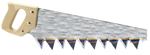
Like the teeth on a saw, leaves and other surfaces can have toothed edges.
incana -- Coated so extensively with hairs as to have a gray/white cast.