Al Schneider's Rocky Mountains Plant Descriptions

Alyssum
Alyssum simplex
Mustard family (Brassicaceae)

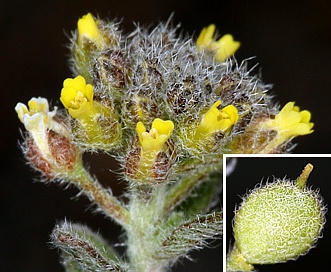
Wild Alyssum is a very common introduced species that carpets large areas of fields and roadsides in the very early spring. Its stems are straight, flowers are tiny and bright yellow, and its seeds are flattened, round, and hairy. A great many plants were eaten, used medicinally, or used for clothing, fuel, and building by humans who populated the earth before supermarkets and Home Depots. Wild Alyssum's scientific name refers to its past use as a supposed cure for rabies: from the Greek "a" ("without") "lyssum" ("madness"). "Simplex" is latin for "unbranched" or "simple," describing the plant's single or straight, unbranched stems.

©2010 Steve Matson
Linnaeus named the Alyssum in 1753.

Description

, weakly rooted, stems erect, up to 10" tall, single or branched near the base. Leaves , up to 1" long. Herbage sparsely covered with star-shaped white hair. Tiny yellow flowers with red forming a sparse cluster. a rounded pod, with star shaped hair and terminated with a 1 .

Field Marks

Short mustard with a small cluster of tiny yellow flowers and star-shaped hairs on herbage and .

© Al Schneider

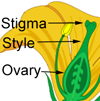
style -- This is a long and thread-like structure that connects the stigma with the ovary. A flower may have a single style, or several of them.

mm -- millimeter. About 1/25th of an inch.

A herb is a plant whose stems die back to the ground in the winter.

An annual plant is a plant that completes its life cycle, from germination to the production of seed, within one year, and then dies.

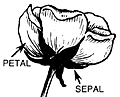
Usually green, sepals typically function as protection for the flower in bud, and often as support for the petals when in bloom.

fruit -- any seed-bearing structure in flowering plants. It is formed from the ovary after flowering.

genus -- A subdivision of a botanical Family in which all members have a significant number of similar characteristics.

lanceolate -- Lance-shaped. Long, wider in the middle.