Al Schneider's Rocky Mountains Plant Descriptions

Northern Rockjasmine
Androsace septentrionalis
Primrose family (Primulaceae)

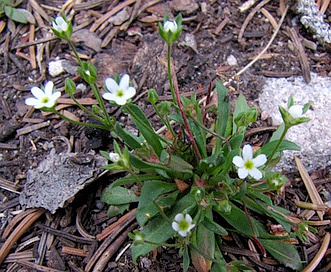
It is amazing how often common things can escape notice: Northern Rockjasmine (Androsace septentrionalis) is very common and often flowers for months, but it is so delicate and tiny that it is often masked by much larger plants. Once noticed, it is easy to spot again and again because of its densely packed and long candelabra stems topped by numerous, tiny white flowers. It is common to find and dotted with scores of Androsace septentrionalis and one can find the same widespread sprinkling of the plants all the way down to the foothills.

Linnaeus named this and species in 1753. "Intermountain Flora" points out that this species has an enormous range, from "Norway and the Alps to the Himalayas and the Pacific shores of Siberia, and in North America... from Alaska to Greenland, south through most of Canada and in the U.S. to California..., Nevada, Idaho, Utah, Arizona, and New Mexico, east to North Dakota, South Dakota, Minnesota, Colorado, and Texas." "Androsace," from the Greek "andr" ("man") and "sakos" ("shield"), refers to some properties of a now unknown plant. "Septentrionalis" is Latin for "northern."

©2012 Bryant Olsen
Description

Very small, delicate (, ?) with narrow leaves in a dense , to , sparsely to densely hairy. Typically one to 9" tall, usually 3-5"). Many flowers in . to 2" long or more, - about 1/10" long, below the . white, minute. Plant turns red after fruiting. a about 1/10" long.

Field Marks

Thread-like stems with tiny white flowers at the ends of long top a of narrow leaves.

© Al Schneider

corolla -- The name for all the petals of a flower taken together.

meadow -- Large grass and wildflower filled area with few, if any, trees.

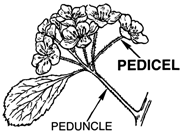
pedicel -- The stem of a single flower.

rosette -- usually a dense cluster of leaves at the base of a plant.

basal leaves -- a leaf that grows lowest on the stem of a plant.

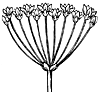
An umbel is a collection of flowers on short stalks which spread from a common point, somewhat like umbrella ribs. The arrangement can vary from being flat-topped to almost spherical.

oblanceolate -- top wider than bottom

lobe -- A rounded parts of a leaf (or other organ).

A herb is a plant whose stems die back to the ground in the winter.

subalpine -- Just below the timberline.

spatulate -- spoon-shaped.

basal -- at the base, situated or attached at the base.

turbinate -- shaped like a spinning top or beetroot.

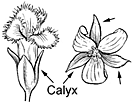
calyx -- the sepals of a flower, typically forming a whorl that encloses the petals and forms a protective layer around a flower in bud.

fruit -- any seed-bearing structure in flowering plants. It is formed from the ovary after flowering.

campanulate -- bell shaped

alpine -- above the tree line. Thin soil, rocks, short growing season, frost, winter snow.

A perennial plant lives and blooms for many years.

An annual plant is a plant that completes its life cycle, from germination to the production of seed, within one year, and then dies.

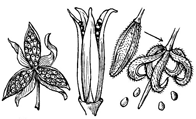
capsule -- a type of simple, dry fruit produced by many species of flowering plants. In most cases the capsule splits apart to release seeds.

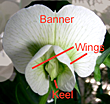
In a pea flower the two bottom petals are fused together forming a boat-like structure called the keel. The glumes of grasses may have a sharp projecting ridge like the keel of a boat.

biennial -- a plant which lives for two years, producing a basal rosette of leaves the first year and a full plant, flower, and seed the second year followed by the death of the entire plant at the end of the second year.

scape -- a long, leafless flower stalk coming directly from a root. The tulip has a scape.

genus -- A subdivision of a botanical Family in which all members have a significant number of similar characteristics.