Al Schneider's Rocky Mountains Plant Descriptions

Mountain Deathcamas
Anticlea elegans
Trillium/Death-Camas family (Melanthiaceae)

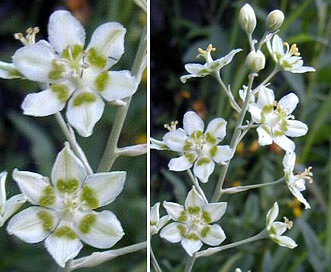
Mountain Death Camas (Anticlea elegans) is a lovely and abundant plant found at higher elevations. Both Mountain Death Camas and its very similar looking foothills cousin, Death Camas, have beautifully airy and symmetrically arching leaves and a long with abundant wide open flowers. Both are very noticeable and very attractive plants. Both are quite poisonous. The are deadly. The two species differ in several main ways: the flower of Mountain Death Camas is about 0.5" wide; the flower of Death Camas is about 0.25" wide. Mountain Death Camas has a more open, elongated flower cluster. Mountain Death Camas has a partially inferior ; has a superior . The on the inside base of each petal are shaped differently on the two species. Small seeming differences, but they are enough to make two different species in two different .

"Anticlea" was the mother of Ulysses and "elegans" is Latin for "elegant." Meriwether Lewis collected the first specimen of this plant in July of 1806 near Lewis and Clark Pass, Montana.

©2009 Barry Breckling
Description

Erect , 12-24" tall, rather , , with slender stem and long, narrow, erect, , leaves from 2-9" long. Flowers are white-cream, yellow-white, or green-white, sometimes tinged with purple in a . Individual flowers have 6 unequal petals that open broadly to expose 6 and 3 and an arched, green near the base of each petal. an .

Field Marks

Dome-shaped flowers in an elongated cluster of white-cream flowers on slender stem with long .

© Al Schneider

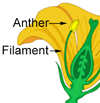
stamen -- the pollen-producing reproductive organ of a flower; The stamen consists of an anther supported by a filament.

terminal -- Located at the end (the tip or the apex).

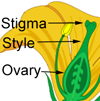
style -- This is a long and thread-like structure that connects the stigma with the ovary. A flower may have a single style, or several of them.

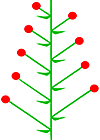
A raceme is an unbranched, indeterminate type of inflorescence bearing flowers having short floral stalks along its axis.

meadow -- Large grass and wildflower filled area with few, if any, trees.

glaucous -- Pale gray or bluish-green. It can mean covered with a greyish, bluish or whitish coating.

A herb is a plant whose stems die back to the ground in the winter.

linear -- Long and very narrow like a blade of grass.

basal -- at the base, situated or attached at the base.

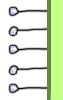
Glands are plant structures that secrete liquids, salts or other substances. Glands often appear as hairs with a drop of liquid at the end.

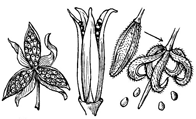
capsule -- a type of simple, dry fruit produced by many species of flowering plants. In most cases the capsule splits apart to release seeds.

fruit -- any seed-bearing structure in flowering plants. It is formed from the ovary after flowering.

stalk -- The supporting structure of an organ. Examples of stalks are stem, peduncle, petiole, ...

basal leaves -- a leaf that grows lowest on the stem of a plant.

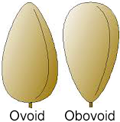
ovoid -- egg-shaped, with the wider portion at the base.

A bulb is an underground stem, the main body of which consists of thickened scales, which are in reality leaves or leaf bases, as in the onion.

An ovary is a part of the female reproductive organ of the flower. Above the ovary is the style and the stigma, which is where the pollen lands and germinates to grow down through the style to the ovary.

genus -- A subdivision of a botanical Family in which all members have a significant number of similar characteristics.

glabrous -- smooth, glossy, having no bristles or hair-like structures. Bald.

A perennial plant lives and blooms for many years.