Al Schneider's Rocky Mountains Plant Descriptions

Western Red Columbine
Aquilegia elegantula
Buttercup family (Ranunculaceae)

Flowers of Western Red Columbine, also called Shooting Star Columbine, have a streamlined elegance. While quite common in open woods where it can go unnoticed in dense greenery, its beauty becomes obvious on rock ledges and other open areas. Flowers appear early in the spring at lower elevations and can be found throughout the mountain growing season. The spurs present on most Aquilegia flowers are unique and give rise to its scientific and common names: "Aquilegia," Latin for "eagle," refers to the Eagle talon-like spurs, while "columbine," Latin for "dove," refers to the flower's resemblance (from the rear or side of the flower) to a group of Doves. The flower occasionally hybridizes with Colorado Blue Columbine (Aquilegia coerulea; the resulting flower displays interesting combinations of both plants.
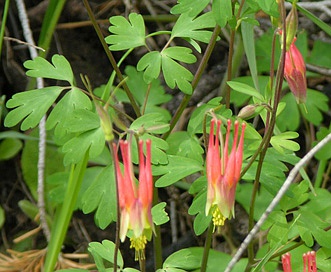

©2007 Jerry Oldenettel
Description

Showy , 6-18" tall with petals pointing forward and spurs backward. Flowers with scarlet-to-orange and prominent spurs folding directly backward. Petal blades yellow with 4 straight surrounded by the numerous (with yellow sacs) protruding beyond the and petals. and stem leaves bi- with deeply cut, rounded . Stems to . are clusters of hairy pods.

Field Marks

Nodding flower with scarlet-orange spurs streaming backward and yellow petal blades pointing forward.

© Al Schneider

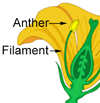
stamen -- the pollen-producing reproductive organ of a flower; The stamen consists of an anther supported by a filament.

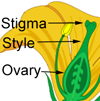
style -- This is a long and thread-like structure that connects the stigma with the ovary. A flower may have a single style, or several of them.

A perennial plant lives and blooms for many years.

lobe -- A rounded parts of a leaf (or other organ).

A herb is a plant whose stems die back to the ground in the winter.

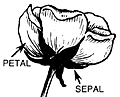
Usually green, sepals typically function as protection for the flower in bud, and often as support for the petals when in bloom.

basal -- at the base, situated or attached at the base.

Glands are plant structures that secrete liquids, salts or other substances. Glands often appear as hairs with a drop of liquid at the end.

fruit -- any seed-bearing structure in flowering plants. It is formed from the ovary after flowering.

The anther is a pad at the end of the stamen that holds the pollen.

ternate -- Leaves in groups of three. Whorls of three. Three leaflets.

glabrous -- smooth, glossy, having no bristles or hair-like structures. Bald.