Kinnikinnick Arctostaphylos uva-ursi Heather family (Ericaceae)
As the common name suggests, this plant is eaten by bears and other wildlife. , being somewhat mealy, are not as tasty to humans. The persist into winter when other are gone. Kinnikinick, an Algonquin word for "tobacco substitute," is a host to yellow witch's broom (distorted growth), which also affects spruce (see Engelmann Spruce account). "Arcto" is Greek for "bear" and "staphylos" is Greek for "a bunch of grapes."
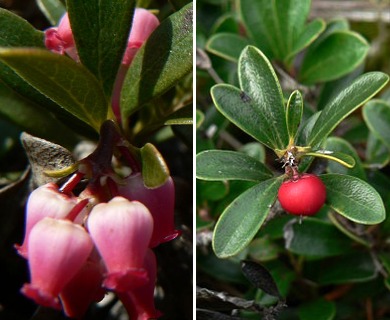
shrub, 4-8" tall, that produces extensive red trailing stems extending up to 10' . Flowers are pink-to-white, urn-shaped with narrow opening, in small hanging clusters at the end of branches ( ). Branches are flexible. Leaves are , shiny dark green, hairless, paddle-shaped, and rounded at tip. are bright red -like containing 4-5 .
An evergreen tree retains a large portion of its green leaves all year.
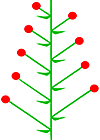
A raceme is an unbranched, indeterminate type of inflorescence bearing flowers
having short floral stalks along its axis.
terminal -- Located at the end (the tip or the apex).
a small nut. A nut being a hard, dry fruit containing only one seed that does not open at maturity.
fruit -- any seed-bearing structure in flowering plants.
It is formed from the ovary after flowering.
The botanical term "berry" is different from common usage. Strawberries and raspberries are not berries.
But a tomatoe is. A true berry is a fruit with the seeds immersed in the pulp.
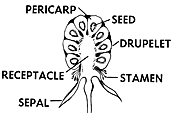
drupe -- A fruit in which an outer fleshy part surrounds a hardened shell containing a seed.
A peach is a drupe. A raspberry is composed of drupelets.
prostrate -- Laying flat on the ground.
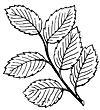
alternate -- leaves alternate along the main stem and
are attached singly.