Al Schneider's Rocky Mountains Plant Descriptions

Rydberg's Arnica
Arnica rydbergii
Aster family (Asteraceae)

Found isolated or in scattered patches, this bright yellow Arnica prefers and rocky areas. Few pairs of widely spaced stem leaves can be slightly . are clustered and usually have . Stems can start off at an angle and then gradually turn vertical. The species name was given in 1899 by Edward Greene to honor Per Axel Rydberg, a giant in Colorado botany, and a major influence on Bill Weber, the present-day Colorado plant authority. Rydberg wrote a "Flora of the Rocky Mountains and Adjacent Plains" in 1917.


©2014 Richard Spellenberg

Description

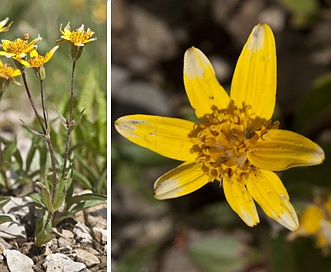
Low-growing with foliage. Flowering stems usually bear a solitary flower head. Occasionally 2-3 flower heads are produced per plant. Flowering stems are often separate from clusters of . Leaves are to in outline, about 2" long and may be toothless or slightly along the margins. Three to four leaf pairs are produced each other along the erect stems, but only the have . Flowers are produced in densely clustered, broadly conical flower heads at the top of stems. A central button of dark yellow flowers is surrounded by 7-10 yellow , each about 0.75 long. is densely short-hairy .
Field Marks

Yellow sunflower with foliage, low-growing in stony soil of and .

© Al Schneider

meadow -- Large grass and wildflower filled area with few, if any, trees.

A perennial plant lives and blooms for many years.

achene -- a type of simple dry fruit produced by many species of flowering plants. For example, a rose hip holds a few achenes.

A herb is a plant whose stems die back to the ground in the winter.

subalpine -- Just below the timberline.

ray flowers -- The outer petals of a sunflower or daisy are ray flowers.

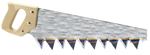
serrate -- toothed with asymmetrical teeth pointing forward; like the cutting edge of a saw.

disc flowers are those in the center of a sunflower or daisy. Not a ray flower.

Glands are plant structures that secrete liquids, salts or other substances. Glands often appear as hairs with a drop of liquid at the end.

Like the teeth on a saw, leaves and other surfaces can have toothed edges.

fruit -- any seed-bearing structure in flowering plants. It is formed from the ovary after flowering.

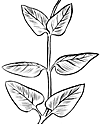
In an opposite leaf arrangement the leaves come in pairs with one leaf on each side of a stem.

elliptic -- Oval, with no point or a very short point.

basal leaves -- a leaf that grows lowest on the stem of a plant.

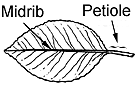
petiole -- the stalk of a leaf.

lanceolate -- Lance-shaped. Long, wider in the middle.

alpine -- above the tree line. Thin soil, rocks, short growing season, frost, winter snow.