Alpine Sagebrush Artemisia scopulorum Aster family (Asteraceae)
Sagewort is very common in high and areas, but it is small and slim, and easily overlooked. The entire plant has a most exotic, even science-fiction-alien appearance. The first specimen of this plant was collected by Hall and Harbour, led by Charles Parry, in 1862 in Colorado and was named by Asa Gray in 1863.
Named in honor of the Greek goddess Artemis. "Scopulorum" means "of rocky places."
Description
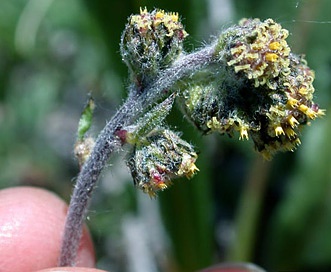
Aromatic , 2-10" tall. Leaves and young twigs typically Silvery blue-green and hairy. Leaves are mostly , and finely cut. Dense gray hairs on both sides lend leaves their silvery blue-green color. Leaves are persist through the winter. Numerous flowerheads in compact clusters consist of small yellow-brown flowers with numerous with curled yellow tips. Has distinctive sage smell when leaves are crushed.