Al Schneider's Rocky Mountains Plant Descriptions

Field Milkvetch
Astragalus agrestis
Pea family (Fabaceae)

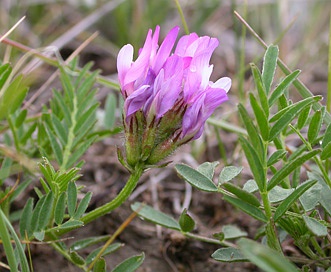
Field Milkvetch (Astragalus agrestis) enjoys areas that are moist in the spring and early summer and in these areas it can spread over many square feet. It has tight clusters of flowers, tightly packed clusters of erect seed pods, and a habit of spreading over large areas through its . These characteristics do, in Astragalus expert Stanley Welsh's words, "set [it] ... apart from others in the [Astragalus] in North America." Welsh does point out that this Astragalus shares some similarities with A. alpinus. The plant was named by David Douglas in 1832 from a collection made by Douglas in 1827. "Agri" is Latin for "field."

©2005 Matt Lavin
Description

with stem 3-13" tall, erect or spreading from . Sparsely to moderately hairy. Plant often in clumps. Leaves to 4" long; 13-23, narrowly to , hairy both sides. to 6" long. 5-15 flowered, the flowers erect to 1" long, pink purple, light yellow-white, or almost white. a pod.

Field Marks

Tightly packed clusters of flowers and seed pods from spreading .

© Al Schneider

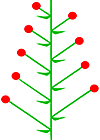
A raceme is an unbranched, indeterminate type of inflorescence bearing flowers having short floral stalks along its axis.

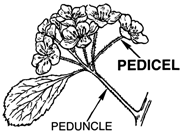
A peduncle is a common stalk of a cluster of flowers.

A perennial plant lives and blooms for many years.

A herb is a plant whose stems die back to the ground in the winter.

ascending -- growing obliquely upward and usually curved.

fruit -- any seed-bearing structure in flowering plants. It is formed from the ovary after flowering.

lanceolate -- Lance-shaped. Long, wider in the middle.

elliptic -- Oval, with no point or a very short point.

genus -- A subdivision of a botanical Family in which all members have a significant number of similar characteristics.

leaflets -- Each little leaf-like thing in a compound leaf is a leaflet.

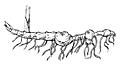
rhizome -- root-like stems that may either grow horizontally at the soil surface or in other orientations underground.