Al Schneider's Rocky Mountains Plant Descriptions

Missouri Milkvetch
Astragalus missouriensis
Pea family (Fabaceae)

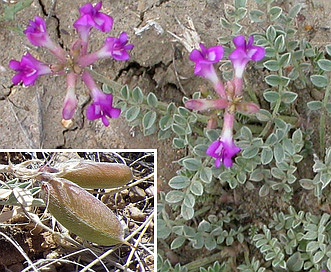
There are several hundred Astragalus species in the West and they are primarily distinguished by the "mature" seed pods. Once you identify the species and repeatedly see it, you recognize it by its flowers, growth pattern, hairiness, and location. This is a good intellectual and observational challenge which rewards you with real feelings for and knowledge about individual plants. Missouri Milkvetch spreads along the ground, no more than a few inches tall, and puts out an abundance of very attractive flowers. , stems, and pods are covered with short hairs. In 1818 Thomas Nuttall named and described Astragalus missouriensis from a specimen collected by Bradbury in the Louisiana Territory near the Missouri River.

©2003 Matt Lavin
Description

, almost stemless, to 5" tall; spreading, sprawling stems to 4" long forming a mat. Leaves 1/2-5" long with 5-15 to 3/4" long, to , hairy on both sides. to over 3" long. short hairy. Flowers to almost an inch long, pink purple, rarely white. Pods to descending, , , to 1" long and 1/3" thick, curved, variably , short hairy.

Field Marks

Low, spreading plant with abundance of bright pink, purple, white flowers and long pods with short, straight, hairs.

© Al Schneider

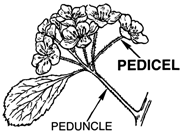
A peduncle is a common stalk of a cluster of flowers.

A perennial plant lives and blooms for many years.

ellipsoid -- Shaped like a watermellon. Smaller.

ascending -- growing obliquely upward and usually curved.

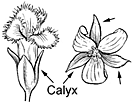
calyx -- the sepals of a flower, typically forming a whorl that encloses the petals and forms a protective layer around a flower in bud.

sessile -- attached without a stalk. For example, a leaf that clasps the stalk. A petiolate leaf has a stalk.

elliptic -- Oval, with no point or a very short point.

obovate -- Teardrop-shaped, stem attaches to tapering point.

appressed -- pressed close or flat against another surface as in hairs appressed against a stem.

leaflets -- Each little leaf-like thing in a compound leaf is a leaflet.

compressed -- flattened lengthwise, either laterally (from side to side) or dorsally (from front to back).