Arrowleaf Balsamroot
Balsamorhiza sagittata
Aster family (Asteraceae)
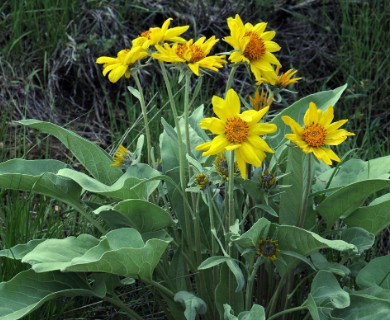
This conspicuous, large plant with showy yellow flowers (to several inches in diameter) dots hillsides in the spring and early summer. Leaves turn brown, persist through the summer, and rattle in the wind. Plant may be confused with various Mulesears species, but the leaves of the two are distinct: Balsamroot leaves are about 4" inches wide, 6-9" long, and arrowhead shaped; Mulesears leaves are 2-4" wide, up to 16" long, and shaped like ears of a mule. Balsamroot also tends to bloom several weeks earlier than Mulesears. Traditionally the seeds, young shoots and roots were eaten by Native Americans. "Balsamorhiza" refers to the Balsam-like taste and smell of the root ("rhiza" in Greek), and "sagittata" is Latin for "arrow," as in "Sagittarius," the legendary archer.
©2011 James L. Reveal
