Al Schneider's Rocky Mountains Plant Descriptions

Alpine Bistort
Bistorta vivipara
Smartweed-Buckwheat family (Polygonaceae)

This is a miniature of the much taller, more conspicuous, and usually more abundant American Bistort (Bistorta bistortoides). It grows in scattered colonies in open, grassy areas. Its very unusual structure makes it well worth bending for. "Vivipara" is Latin for "brings forth alive," and a viviparous plant asexually produces plants genetically identical to itself as sprouts on itself. In the case of Bistorta vivipara, bulblets are produced below (or entirely replacing) the tiny flowers. These bulblets fall to the ground and can grow into mature plants. The more common Bistorta bistortoides is not viviparous. Human beings are viviparous in the zoological sense: we give birth to live young. Linnaeus named this plant Polygonum viviparum in 1753 and Delarbre renamed it Bistorta vivipara in 1800.
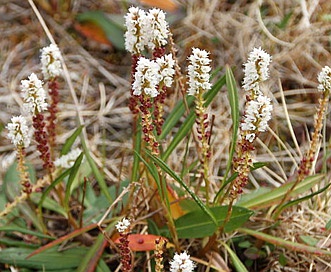

©2012 "Bjoertvedt"
Description

, erect from short bases. Stems from 3-15" tall, well developed to 10" long and one inch wide, to , , or oval. well developed. reduced upward. Flowers several to numerous borne in to 5" long, at least the lower and sometimes all are replaced by bulblets. minute, 5-, green with white to pink margins. often vestigial. 3, . , 3 angled, brown, lustrous, seldomly developing.

Field Marks

Very slender plant with few arching leaves on long and tight cluster of minute flowers and bulblets.

© Al Schneider

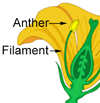
stamen -- the pollen-producing reproductive organ of a flower; The stamen consists of an anther supported by a filament.

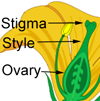
style -- This is a long and thread-like structure that connects the stigma with the ovary. A flower may have a single style, or several of them.

A perennial plant lives and blooms for many years.

cauline leaves -- leaves growing on a stem and especially on the upper part.

achene -- a type of simple dry fruit produced by many species of flowering plants. For example, a rose hip holds a few achenes.

perianth -- the non-reproductive part of the flower such as petals and sepals.

terminal -- Located at the end (the tip or the apex).

fruit -- any seed-bearing structure in flowering plants. It is formed from the ovary after flowering.

exserted -- projected beyond. (Exserted stamens project beyond the corolla tube.)

elliptic -- Oval, with no point or a very short point.

basal leaves -- a leaf that grows lowest on the stem of a plant.

lobe -- Being divided by clefts.

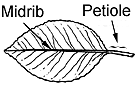
petiole -- the stalk of a leaf.

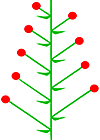
A raceme is an unbranched, indeterminate type of inflorescence bearing flowers having short floral stalks along its axis.

lanceolate -- Lance-shaped. Long, wider in the middle.

oblong -- Having an elongated form with somewhat parallel sides. Rectangular.