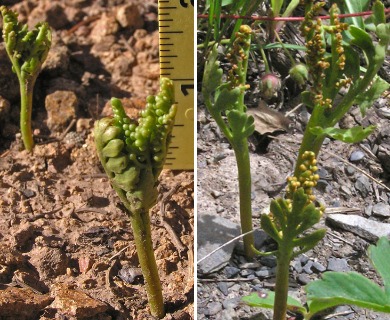
Echo Moonwort Botrychium echo Grapeferns family (Ophioglossaceae)
Botrychium echo is found only in the Four Corners states of Colorado, New Mexico, Arizona, and Utah. B. echo, B. neolunaria, B. hesperium, B. lanceolatum, and B. minganense are the most common Botrychiums in Colorado, but even these are considered rare by some sources. However, Botrychiums are so difficult to find that we really do not know their abundance or distribution. Many Botrychium grow in similar habitats and it is common to find a number of species near each other. Botrychium echo was described in 1983 by Drs. Warren and Florence Wagner from a specimen collected at Glacier Lake near Ward, Colorado. The specific epithet, "echo" was given because it echoes, i.e., possesses characteristics of many other Moonwort species.
Fern-like plants to 6" tall, the common of the sporophore and trophophore normally about 2" tall, sporophore short 1+" tall, about 1 1/2 times the length of the trophophore. Sterile trophophore bright green and shiny, nearly to short-, broadly , almost an inch long. not overlapping, to with pointed . pair not longer with more widely spreading lower division. Reproduces from .
linear -- Long and very narrow like a blade of grass.
pinnae -- the primary segments of a compound leaf.
The apex is the tip or the furthest point from the attachment.
spores are produced by ferns, horsetails, and other primitive plants.
Spores are like tiny seeds, but they lack food for the plant embryo.
Because spores are easily carried aloft by the wind, they allow ferns
and horsetails to reproduce asexually across considerable distances.
basal -- at the base, situated or attached at the base.
stalk -- The supporting structure of an organ. Examples of stalks are stem, peduncle, petiole, ...
sessile -- attached without a stalk. For example, a leaf that clasps the stalk. A petiolate leaf has a stalk.
lanceolate -- Lance-shaped. Long, wider in the middle.
oblong -- Having an elongated form with somewhat parallel sides. Rectangular.