Al Schneider's Rocky Mountains Plant Descriptions

Gunnison's Mariposa Lily
Calochortus gunnisonii
Lily family (Liliaceae)

The of Mariposa-lilies are sweet and nutritious, raw or cooked. C. nuttallii helped sustain Mormon settlers in 1847 and is now the state flower of Utah. There are a number of Mariposa-lily species, primarily distinguished by markings on the inner surface of the petals and the petal colors.

"Calochortus," from the Greek "kalos," means "beautiful," and "chortos" means "grass," referring to the grass-like leaves. C. gunnisonii is named for Captain J. W. Gunnison, 1812-1853, surveyor, explorer, and expedition leader who, with eight companions, was murdered in Utah while working on a railroad route survey. Gunnison is honored in many names: Gunnison Grouse; the Gunnison River; Gunnison, Colorado; etc.

©2007 Al Schneider
Description

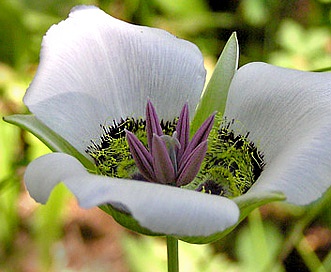
, 6-18" tall arising from onion-like with two to four grass-like leaves. Flowers white to a bit lavender with 3 , broadly cupped petals with rounded tips and 3 narrower, white-green . A purple circles the base of the petals, densely bearded with a yellow fringe. Five erect circle the .

Field Marks

Showy 3-petaled flower with yellow fringe inside bowl.

© Al Schneider

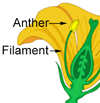
stamen -- the pollen-producing reproductive organ of a flower; The stamen consists of an anther supported by a filament.

A perennial plant lives and blooms for many years.

A herb is a plant whose stems die back to the ground in the winter.

ovate -- Oval, egg-shaped, with a tapering point.

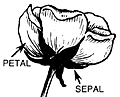
Usually green, sepals typically function as protection for the flower in bud, and often as support for the petals when in bloom.

Glands are plant structures that secrete liquids, salts or other substances. Glands often appear as hairs with a drop of liquid at the end.

A bulb is an underground stem, the main body of which consists of thickened scales, which are in reality leaves or leaf bases, as in the onion.

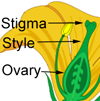
A pistil is the female structure of many flowers. It contains one or more carpels. Each carpel contins an ovary, style and stigma. The stigma receives the pollen which grows thru the style to reach the ovary.