Al Schneider's Rocky Mountains Plant Descriptions

Harebell
Campanula rotundifolia
Harebell family (Campanulaceae)

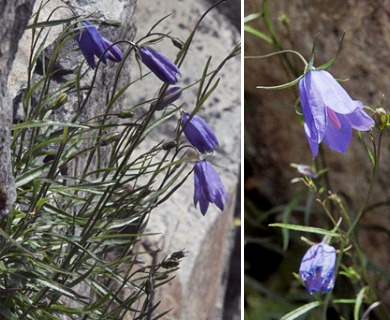
Harebell's are among the more popular and well-known wildflowers of the Rockies. They grow in small to large groupings making them very noticeable and attractive. Their close Colorado and New Mexico Rockies cousin, Parry's Bluebells (Campanula parryi), is quite similar but it has longer , more deeply notched petals, and its flowers are upright. The common name "harebell" arises from the folk belief that witches used juice squeezed from the flower to turn themselves into hares. The plant is also known as Puck's thimble and was traditionally linked to fairies and witches. Linnaeus named the Campanula in 1753. The family and names, "Campanulaceae" and "Campanula" are derived from the Latin, "campan," "bell."

©2014 Susan McDougall, Trees Live Here.
Description

Slender , 4-36" tall, with milky sap. Blue-violet bell-shaped flowers hang in clusters along the top parts of nodding, thread-like, mostly unbranched stems that grow in small to very large patches. Flowers with 5 pointed that gently curve back, a 3-part on a about as long as the , and 5 lavender . on long with broadly to , margins may be or ; stem and .

Field Marks

Purple-blue bell-shaped flowers nodding from slender stems.

© Al Schneider

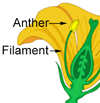
stamen -- the pollen-producing reproductive organ of a flower; The stamen consists of an anther supported by a filament.

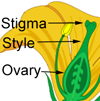
style -- This is a long and thread-like structure that connects the stigma with the ovary. A flower may have a single style, or several of them.

cordate -- heart-shaped.
subcordate -- somewhat heart-shaped.

A perennial plant lives and blooms for many years.

lobe -- A rounded parts of a leaf (or other organ).

A herb is a plant whose stems die back to the ground in the winter.

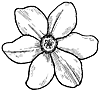
corolla -- The name for all the petals of a flower taken together.

ovate -- Oval, egg-shaped, with a tapering point.

An entire leaf has smooth edges. Not toothed or lobed.

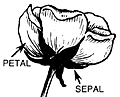
Usually green, sepals typically function as protection for the flower in bud, and often as support for the petals when in bloom.

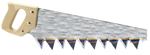
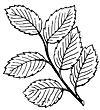
Like the teeth on a saw, leaves and other surfaces can have toothed edges.

basal leaves -- a leaf that grows lowest on the stem of a plant.

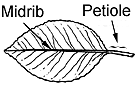
petiole -- the stalk of a leaf.

stigma - The tip of a pistil that receives the pollen.

genus -- A subdivision of a botanical Family in which all members have a significant number of similar characteristics.

blade -- Just the flat part of a leaf. Not the stem.

leaves alternate along the main stem and are attached singly.

linear -- Long and very narrow like a blade of grass.