Al Schneider's Rocky Mountains Plant Descriptions

Rhexia-leaved Paintbrush
Castilleja rhexiifolia
Broomrape/Paintbrush family (Orobanchaceae)

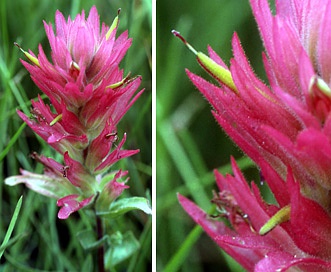
Rhexia-leaved Paintbrush is similar in appearance to Giant Red Paintbrush (C. miniata), and the two may be found growing together, though Giant Red Paintbrush usually grows at lower elevations. Rhexia-leaved Paintbrush has vivid rose-pink that are not deeply divided. Rhexia-leaved Paintbrush commonly hybridizes with Giant Red Paintbrush and even more with Northern Paintbrush (Castilleja septentrionalis). The latter hybrids produce spectacular colors. Rhexia-leaved Paintbrush might be confused with Hayden's Paintbrush (Castilleja haydenii) but the latter is far less common, found only on , and it is consistently pink, very hairy, and never more than a few inches tall.

"Rhexifolia" is Greek for "broken foliage" and probably refers to the strongly veined leaves and their resemblance to the veins of the eastern U.S. , Rhexia.

©1977 J Schmidt
Description

, 4-16" tall, with and bright purple-rose to pink-red. often have 2-4 at the tip, and hide small purple-red tubular flowers. Numerous stems bear leaves that are (not or ), , 3-, and narrowly . a .

Field Marks

Bright purple-red, showy, leafy at high elevations.

© Al Schneider

nerves -- Another name for a vein.

An entire leaf has smooth edges. Not toothed or lobed.

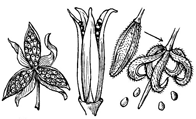
capsule -- a type of simple, dry fruit produced by many species of flowering plants. In most cases the capsule splits apart to release seeds.

A perennial plant lives and blooms for many years.

lobe -- A rounded parts of a leaf (or other organ).

A herb is a plant whose stems die back to the ground in the winter.

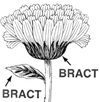
Bracts are modified leaves associated with a flower.

tundra -- Land above tree line characterized by a short growing season, intense sun and wind, thin soils, very high snow fall and high rain fall. Contains low growing sedges, grasses, dwarf shrubs and herbs.

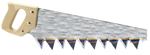
Like the teeth on a saw, leaves and other surfaces can have toothed edges.

fruit -- any seed-bearing structure in flowering plants. It is formed from the ovary after flowering.

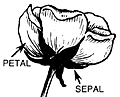
Usually green, sepals typically function as protection for the flower in bud, and often as support for the petals when in bloom.

lobe -- Being divided by clefts.

genus -- A subdivision of a botanical Family in which all members have a significant number of similar characteristics.

alternate -- leaves alternate along the main stem and are attached singly.

lanceolate -- Lance-shaped. Long, wider in the middle.

alpine -- above the tree line. Thin soil, rocks, short growing season, frost, winter snow.