Al Schneider's Rocky Mountains Plant Descriptions

Fendler's Ceanothus
Ceanothus fendleri
Buckthorn family (Rhamnaceae)

Fendler's Ceanothus (Ceanothus fendleri) often grows in small clumps in forested areas, but it can spread over hundreds of square feet in more open areas. Tiny puffs of flowers in numerous clumps surmount narrow dark green leaves on this low, spreading, somewhat spiny shrub. Ceanothus fendleri commonly grows to three feet tall and is almost always wider than tall. Ceanothus fendleri is fairly common in coniferous open woods, and it attracts attention with its numerous bright white flowers. Where you find one shrub, you almost always will find several.

Linnaeus named this in 1753 and in 1849 Asa Gray named this species from a specimen collected near Santa Fe, New Mexico by Augustus Fendler in 1847. "Ceanothus" is Greek referring to a kind of Thistle. Augustus Fendler was a well-known nineteenth century plant collector.
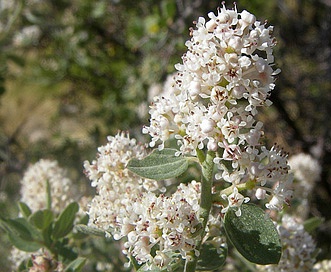

©2012 Anthony Mendoza

Description

Low, rounded to spreading, thorny shrubs, mainly 8-32" tall. , , with 1/8 to 1" long and about 1/5" wide, to or , or , pale and hairy beneath. very small, petals hooded, 5 times the size of the , white. a with shiny brown seeds.

Field Marks

Spreading shrub with small, dark green leaves, , and numerous clusters of tiny white flowers.

© Al Schneider

An entire leaf has smooth edges. Not toothed or lobed.

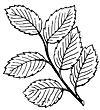
serrate -- toothed with asymmetrical teeth pointing forward; like the cutting edge of a saw.

thorn -- a sharp, still point, usually a modified stem, that cannot be detached without tearing the subtending tissue. A spine.

ovate -- Oval, egg-shaped, with a tapering point.

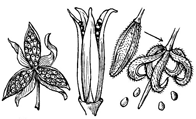
capsule -- a type of simple, dry fruit produced by many species of flowering plants. In most cases the capsule splits apart to release seeds.

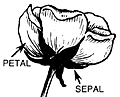
Usually green, sepals typically function as protection for the flower in bud, and often as support for the petals when in bloom.

Deciduous plants are those that lose all of their leaves for part of the year.

fruit -- any seed-bearing structure in flowering plants. It is formed from the ovary after flowering.

elliptic -- Oval, with no point or a very short point.

montane -- inhabiting mountainous country but below timberline.

genus -- A subdivision of a botanical Family in which all members have a significant number of similar characteristics.

blade -- Just the flat part of a leaf. Not the stem.

leaves alternate along the main stem and are attached singly.

oblong -- Having an elongated form with somewhat parallel sides. Rectangular.