Al Schneider's Rocky Mountains Plant Descriptions

Sugar Hackberry
Celtis laevigata
Hemp/Hops/Hackberries family (Cannabaceae)

For Celtis laevigata variety reticulata

The tree can most often be found along streams and in canyon bottoms. The are edible and extensively utilized by wildlife. "Reticulata" means "net-veined" and refers to the vein pattern on the leaves. Hackberry is often a gnarled, stunted tree afflicted with numerous insect leaf- infestations. The tree is most often found in canyon bottoms near seeps, pour-offs, and streams. can occasionally reach unblemished and edible maturity but most often is so afflicted by blights that it is not edible. Hackberry bark usually has numerous small wart-like bumps. Linnaeus named this species in 1753 using an ancient name assigned by Pliny to a sweet Lotus.


©2012 Sonnia Hill
Description

A small tree, up to 15' tall, and about as wide. The leaves are oval, with a wider base tapering to a long point, thick and sandpapery to touch, and with net-like veins. The bark is up to 1" thick, with prominent ridges and furrows. The is a , with thin sweet flesh, and maturing to a red or orange color.

Field Marks

Small tree or large shrub with a round shape, small red , and net-veined leaves.

© Al Schneider

gall -- An abnormal bulbous formation on plant leaves or stems.

fruit -- any seed-bearing structure in flowering plants. It is formed from the ovary after flowering.

The botanical term "berry" is different from common usage. Strawberries and raspberries are not berries. But a tomatoe is. A true berry is a fruit with the seeds immersed in the pulp.

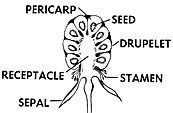
drupe -- A fruit in which an outer fleshy part surrounds a hardened shell containing a seed. A peach is a drupe. A raspberry is composed of drupelets.