Al Schneider's Rocky Mountains Plant Descriptions

Diffuse Knapweed
Centaurea diffusa
Aster family (Asteraceae)

The plants may be , biennials, or short-lived . Centaurea diffusa occurs along roadsides and other disturbed areas from about 5,000 to 8,000 feet in elevation. There are nearly 400 species of this centered in the Mediterranean region. Believed to have been accidentally introduced to the United States in contaminated Alfalfa, the species is now a widespread weed. During the juvenile stage, Diffuse Knapweed is a with deeply divided borne on short stalks on a central with a . When mature, the plant is readily broken off and its tumbleweed-like mobility spreads its seeds. The was named for the centaur, Greek mythological half-man, half-horse famous for his knowledge of medicinal plants.
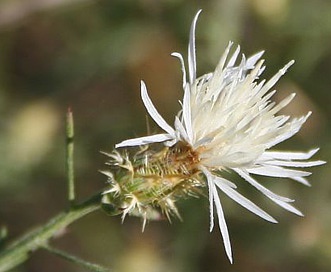

©2008 Franz Xaver

Description

Introduced , or short-lived , 4-24" tall, with diffuse branching that gives plant a ball-like form. Numerous narrow white-purple flowers, singly or in clusters of 2-3, on branches, with only. below is densely bristly. Leaves are stalkless, woolly-hairy, getting smaller and less divided higher up the stem. are with white hair-like () that vary from -like to 1/8 the length of the seed.

Field Marks

White-purple ray-less flowerheads, bristly , and round plant form.

© Al Schneider

terminal -- Located at the end (the tip or the apex).

ray flowers -- The outer petals of a sunflower or daisy are ray flowers.

rosette -- usually a dense cluster of leaves at the base of a plant.

pinnatifid -- A leaf shape that is pinnately lobed but not cut all the way to the axis.

bristle -- A straight, stiff hair.

A noxious weed is considered to be harmful to the environment or animals. Often a governing body designates plants as noxious.

disc flowers are those in the center of a sunflower or daisy. Not a ray flower.

An annual plant is a plant that completes its life cycle, from germination to the production of seed, within one year, and then dies.

pappus -- Small scales, bristles or hairs at the top of the seed in Asteraceae. For example, dandelion parachutes. Plural: pappi.

taproot -- The primary decending root of a plant.

achene -- a type of simple dry fruit produced by many species of flowering plants. For example, a rose hip holds a few achenes.

fruit -- any seed-bearing structure in flowering plants. It is formed from the ovary after flowering.

floret -- A small flower, as in the small flowers that make up an Asteraceae flower head.

scale -- A very small leaf around a dormant bud. Also other things that might remind one of fish scales on the surface of ferns, stems and the like.

biennial -- a plant which lives for two years, producing a basal rosette of leaves the first year and a full plant, flower, and seed the second year followed by the death of the entire plant at the end of the second year.

basal leaves -- a leaf that grows lowest on the stem of a plant.

canopy -- The foliage of a tree; the crown. Also the upper layer of a forest.

genus -- A subdivision of a botanical Family in which all members have a significant number of similar characteristics.

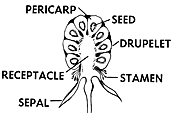
The receptacle is the thickened part of a stem (pedicel) from which the flower organs grow.

A perennial plant lives and blooms for many years.