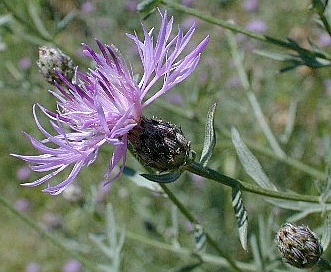
Spotted Knapweed Centaurea stoebe Aster family (Asteraceae)
Spotted Knapweed is one of three invasive knapweeds. Russian Knapweed (C. repens) is a bushier plant, with roots that often form dense colonies; flower have rounded papery tips and lack black spots, , or sharp tips. Diffuse or White Knapweed (C. diffusa) grows up to 2' tall from a single with greatly divided, feathery leaves covered with small hairs. Numerous whitish flowers grow singly or in clusters at end of stems. are yellow-green, triangular, with tips. The was named for the centaur, Greek mythological half-man, half-horse, famous for his knowledge of medicinal plants.
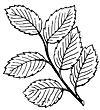
Introduced to short-lived , 1-4' tall. Single pink-purple flower on branches, with only. () below have dark spotted tips. Stem leaves are with sandpaper-like surface. Leaves are cut into narrow , somewhat short-hairy, commonly with translucent dots. One-to-many branches grow out of a of deeply gray-green leaves radiating from a common center. are with white hair-like ().
achene -- a type of simple dry fruit produced by many species of flowering plants.
For example, a rose hip holds a few achenes.
taproot -- The primary decending root of a plant.
rosette -- usually a dense cluster of leaves at the base of a plant.
disc flowers are those in the center of a sunflower or daisy. Not a ray flower.
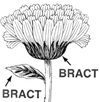
Bracts are modified leaves associated with a flower.
terminal -- Located at the end (the tip or the apex).
bristle -- A straight, stiff hair.
basal leaves -- a leaf that grows lowest on the stem of a plant.
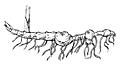
rhizome -- root-like stems that may either grow horizontally at the
soil surface or in other orientations underground.
phyllaries -- Leaflike bracts covering the flowers before opening and remaining under the
flower after it opens. Also called "bracts". Only used with the sunflower family (Asteraceae).
lobe -- A rounded parts of a leaf (or other organ).
A herb is a plant whose stems die back to the ground in the winter.
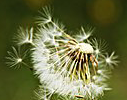
pappus -- Small scales, bristles or hairs at the top of the seed in Asteraceae. For example,
dandelion parachutes. Plural: pappi.
basal -- at the base, situated or attached at the base.
fruit -- any seed-bearing structure in flowering plants.
It is formed from the ovary after flowering.
floret -- A small flower, as in the small flowers that make up an Asteraceae flower head.
alternate -- leaves alternate along the main stem and
are attached singly.
A perennial plant lives and blooms for many years.
spine -- a stiff, sharp structure formed by the modification of a plant organ that contains vascular tissue. A spine can be formed by a latteral branch, a modified leaf or a thorn.
pinnate -- A compound leaf with two rows of leaflets.
biennial -- a plant which lives for two years, producing a basal rosette of leaves
the first year and a full plant, flower, and seed the second year followed by
the death of the entire plant at the end of the second year.
genus -- A subdivision of a botanical Family in which all members have a significant
number of similar characteristics.