Al Schneider's Rocky Mountains Plant Descriptions

Field Chickweed
Cerastium arvense
Pink family (Caryophyllaceae)

There are a number of look-alike chickweeds and some chickweeds, such as Field Chickweed (Cerastium arvense), vary widely in their structure. The "Flora of North America" indicates that Cerastium arvense is "remarkably variable... and grows in a diversity of habitats, making it difficult to ... distinguish" from a number of other Cerastiums. Carefully study the floral parts and the leaves. The very similar appearing Bering Chickweed (C. beeringianum) is found in the same habitats as Field Chickweed but tends to favor settings. It has green-to-red edged vs. thin, dry, not green edges; usually broader leaves; and has no tufts of leaves in its leaf axils. William Weber, Colorado flora authority, indicates that where the two species contact each other they may hybridize, "in which case there is no sure way to distinguish them."

Chickweeds have been traditionally used as astringents to cause tissues to contract. The name means "horned" and refers to its curved seed . "Arvense" means "of the fields."


©2008 Walter Siegmund
Description

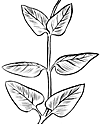
, 4-12" tall, often growing in large mats. White flowers have 5 deeply notched petals about 3 times as long as the , 10 , and 5 . below flowers are with thin yellow margin. Slender leaves arranged on stems with secondary leaves arising from axils of larger primary leaves. a .

Field Marks

Plants grow in large colonies and have widely spaced slender leaves and flowers with five deeply notched white petals.

© Al Schneider

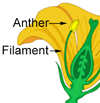
stamen -- the pollen-producing reproductive organ of a flower; The stamen consists of an anther supported by a filament.

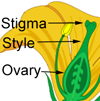
style -- This is a long and thread-like structure that connects the stigma with the ovary. A flower may have a single style, or several of them.

A perennial plant lives and blooms for many years.

membranous -- thin, somewhat translucent and flexible.

A herb is a plant whose stems die back to the ground in the winter.

linear -- Long and very narrow like a blade of grass.

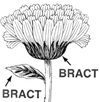
Bracts are modified leaves associated with a flower.

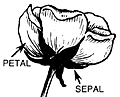
Usually green, sepals typically function as protection for the flower in bud, and often as support for the petals when in bloom.

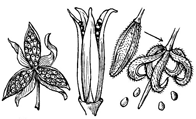
capsule -- a type of simple, dry fruit produced by many species of flowering plants. In most cases the capsule splits apart to release seeds.

fruit -- any seed-bearing structure in flowering plants. It is formed from the ovary after flowering.

In an opposite leaf arrangement the leaves come in pairs with one leaf on each side of a stem.

genus -- A subdivision of a botanical Family in which all members have a significant number of similar characteristics.

lanceolate -- Lance-shaped. Long, wider in the middle.

alpine -- above the tree line. Thin soil, rocks, short growing season, frost, winter snow.