Al Schneider's Rocky Mountains Plant Descriptions

Heath-leaved Chaetopappa
Chaetopappa ericoides
Aster family (Asteraceae)

Heath-leaved Chaetopappa is tiny, beautifully symmetrical, delicate, and bright. Ray flower petals commonly curl downward in the evening and straighten by mid-morning. Heath-leaved Chaetopappa's low and very slender structure, habit of growing in well-spaced colonies (but sometimes in tight clusters), and usually bright white flowers make it relatively easy to identify.

"Chaetopappa" is Greek for "bristly ." "Ericoides," also Greek, means "similar to" ("oides") Heath ("eric"), i.e., the plant's leaves are similar to those of some Heaths.
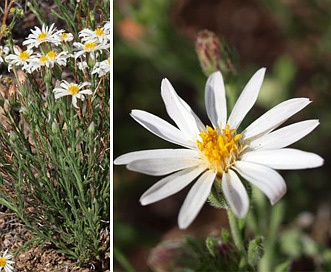

© Sue Smith @
http://cals.arizona.edu/yavapaiplants

Description

Diminutive , 2-5" tall, forming colonies, sometimes dense, sometimes very loose and many feet in diameter, from deep roots. Leaves , mid- strongly raised, short-stiff hairs along the margins. White (infrequently suffused with pink) with yellow flowers which number from 12 to 25. from 8-25. The plant is often (sticky) causing grains of sand to stick to the plant. an .

Field Marks

Very slender and short composite with white flowers and short leaves with bristly margins.

© Al Schneider

nerves -- Another name for a vein.

A perennial plant lives and blooms for many years.

ray flowers -- The outer petals of a sunflower or daisy are ray flowers.

achene -- a type of simple dry fruit produced by many species of flowering plants. For example, a rose hip holds a few achenes.

disc flowers are those in the center of a sunflower or daisy. Not a ray flower.

ray flowers -- The outer petals of a sunflower or daisy are ray flowers.

pappus -- Small scales, bristles or hairs at the top of the seed in Asteraceae. For example, dandelion parachutes. Plural: pappi.

Glands are plant structures that secrete liquids, salts or other substances. Glands often appear as hairs with a drop of liquid at the end.

fruit -- any seed-bearing structure in flowering plants. It is formed from the ovary after flowering.

linear-oblanceolate -- Elongate and exceedingly narrow with the sides more or less straight but gradually becoming broader near the apex.

linear -- Long and very narrow like a blade of grass.