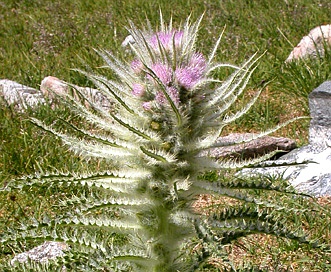
It comes as a surprise to many people that we have a good number of native thistles, so don't pull unless you know. Cirsium scariosum can be six feet tall or have no stem and lie plastered to the ground. It is a distinct thistle because of this growth habit, its stemless flowers tucked into the leaf axils, and its very light green leaves and stems.
Cirsium scariosum was first collected for science by Thomas Nuttall in Idaho in the 1830s and was named by Nuttall in 1841. "Cirsium," is Greek for "dilated vein" from the bygone belief that a thistle distillate opens clogged veins. We now know that only Draino does that. "Scariosum" is for "," i.e., shriveled, not green. This probably refers to the very light leaf and stem color and/or to the tips of the .
Description
Leafy, thick , 8-40" tall with 1-8 creamy white to pink to purple flowers forming a large flowerhead. Fleshy stem with large gray green leaves that clasp the stem at their base. Leaves have -tipped on their margins and smooth upper surfaces. Stems and leaves are covered with long white hairs that extend into the flowerheads.
synonym -- In botany a synonym is a species name that at one time was thought to
be the correct name for a plant but was later found to be incorrect and has been
replaced by a new name.
A perennial plant lives and blooms for many years.
phyllaries -- Leaflike bracts covering the flowers before opening and remaining under the
flower after it opens. Also called "bracts". Only used with the sunflower family (Asteraceae).
spine -- a stiff, sharp structure formed by the modification of a plant organ that contains vascular tissue. A spine can be formed by a latteral branch, a modified leaf or a thorn.
disc flowers are those in the center of a sunflower or daisy. Not a ray flower.
lobe -- A rounded parts of a leaf (or other organ).
stalk -- The supporting structure of an organ. Examples of stalks are stem, peduncle, petiole, ...