Al Schneider's Rocky Mountains Plant Descriptions

Maiden Blue Eyed Mary
Collinsia parviflora
Plantain family (Plantaginaceae)

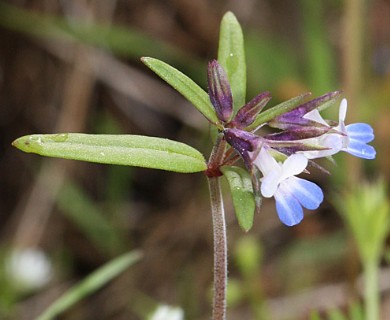
One of the smallest wildflowers in the region, Blue-eyed Mary often grows where other vegetation is sparse. The plant is easily overlooked. It often grows in significantly large numbers and that helps attract attention to it. "Collinsia" was named for Zaccheus Collins, 1764-1831, eminent botanist from Philadelphia. "Parviflora" is Latin for "small-flowered." Blue-eyed Mary is often in the company of Microsteris gracilis.


©2011 Walter Siegmund

Description

Tiny delicate , 2-4" tall. , narrow, to , with margins. Lower leaves broader and , soon withered; upper leaves narrower, becoming stalkless, often in whorls of 3-5. Small blue flowers with white lips on weak stalks arise in groups of 1-6 from upper leaf axils. Flowers are less than .25" long and are comprised of a brown , 2- upper lip, 3- lower lip, and 4 tucked behind middle .
Field Marks

Slender plant with pale blue hump-backed flowers and opposite leaves.

© Al Schneider

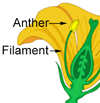
stamen -- the pollen-producing reproductive organ of a flower; The stamen consists of an anther supported by a filament.

An entire leaf has smooth edges. Not toothed or lobed.

linear -- Long and very narrow like a blade of grass.

lobe -- A rounded parts of a leaf (or other organ).

A herb is a plant whose stems die back to the ground in the winter.

An annual plant is a plant that completes its life cycle, from germination to the production of seed, within one year, and then dies.

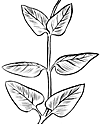
In an opposite leaf arrangement the leaves come in pairs with one leaf on each side of a stem.

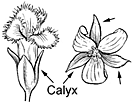
calyx -- the sepals of a flower, typically forming a whorl that encloses the petals and forms a protective layer around a flower in bud.

stalk -- The supporting structure of an organ. Examples of stalks are stem, peduncle, petiole, ...

lanceolate -- Lance-shaped. Long, wider in the middle.

lobe -- Being divided by clefts.