Bastard Toadflax
Comandra umbellata
Mistletoe/Toadflax family (Santalaceae)
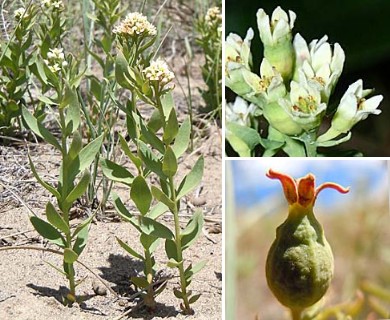
Bastard Toadflax (Comandra umbellata) is , sometimes attaching itself to the roots of other plants and deriving at least some nourishment from them. The plant has green leaves and thus also photosynthesizes. It spreads by underground roots and can form large colonies in and along roadsides, or it can grow in small numbers, even inserting itself into rock crevices. The star-shaped flowers are white to pink, tiny, and massed. Leaves are short and somewhat thick, resembling those of a succulent. The plant is not a relative of Toadflax but someone thought the leaves resembled those of Toadflax, hence the common name. Comandra umbellata is a relative of the Australian Sandalwoods, and our species is one of only two worldwide in this .
The plant was first named Thesium umbellata by Linnaeus in 1753, but in 1818 Thomas Nuttall moved it to the new , "Comandra," which he created. "Comandra" is from the Greek for "male hairs" and refers to hairs on the . "Umbellata," "umbrella like," refers to the shape of the flower clusters -- though we now call this shape a "."
©2011 Matt Lavin, ©2022 Katherine Baird