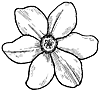
The rare Case's Corydalis (Corydalis caseanabrandegei) grows from three to six feet tall, dies back to the ground in the fall, and starts its rapid growth again soon after snow-melt. Flowers are about three-quarters of an inch long and vary from white to shades of pinks and purples. Professor Joan Maloof of Salisbury University has studied Colorado's Case's Corydalis since 1996 after she noticed that bees were biting through the rear of the flower to extract . She wondered if these plants are rare because the bees were decreasing their reproductive capacity. Her research has shown that Corydalis caseana depends on pollinators which are not driven away by the "robber bees," and that although the robber bees tear through most flowers, they are not interfering with the plant's reproductive capacities.
Asa Gray named Corydalis caseana in 1874 and there are now eight recognized that grow from northern California into Oregon, Washington, Idaho, and Utah. "Caseana" is for Professor E. L. Case of California, and "brandegei" is for Townshend Brandegee who was the botanist on the first Southwest Colorado explorations of the Hayden Survey in 1875. Brandegee found the Colorado growing in the "Piedra Mountains, 10,000 feet altitude."
Description
plant with watery juice, and . Stems to 6' tall, stout, mostly erect. Leaves are large, 8-12" long, divided, some , about 1" long, oval or to . about 1" long with a spur longer than the body, pink to white to purple to rose. a .
nectar -- A sweet fluid produced by the nectary in flowers and collected by bees and other insects.
A herb is a plant whose stems die back to the ground in the winter.
corolla -- The name for all the petals of a flower taken together.
reflexed -- bent sharply back or down.
glaucous -- Pale gray or bluish-green. It can mean covered with a greyish,
bluish or whitish coating.
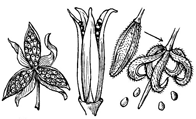
capsule -- a type of simple, dry fruit produced by many species of flowering plants. In
most cases the capsule splits apart to release seeds.
fruit -- any seed-bearing structure in flowering plants.
It is formed from the ovary after flowering.
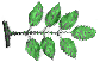
pinnate -- A compound leaf with two rows of leaflets.
lanceolate -- Lance-shaped. Long, wider in the middle.
obovate -- Teardrop-shaped, stem attaches to tapering point.
lobe -- Being divided by clefts.
subspecies -- Plants within a species can be divided into two or more supspecies
when a botanist gives them subspecies names and describes how the subspecies differ.
Often, variety and subspecies are used interchangeably.
glabrous -- smooth, glossy, having no bristles or hair-like structures. Bald.
leaflets -- Each little leaf-like thing in a compound leaf is a leaflet.
A perennial plant lives and blooms for many years.