Al Schneider's Rocky Mountains Plant Descriptions

Upland Larkspur
Delphinium nuttallianum
Buttercup family (Ranunculaceae)

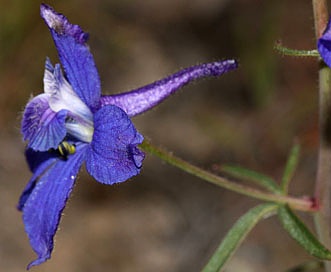
In the early spring Upland Larkspur (Delphinium nuttallianum), a lovely violet-blue larkspur (the spur on the rear of the flower is a key to identifying Delphiniums), appears in the mountains up to 9,500 feet in elevation in solitary patches in open woods and also in massive arrays in . Delphinium nuttallianum commonly produces two, short, deeply dissected early in the spring and then puts up a 6-to-12 inch leafless flower . By the time the flowers are fully opened, the are usually withered.

Linnaeus named this in 1753. "Delphinium" is from the Latin "delphinus," "Dolphin," for the resemblance of the flower buds to Dolphins. In 1843 Pritzel named this species for Thomas Nuttall, the highly praised 19th century botanist, explorer, and Harvard Professor. See the much larger but similar species, Larkspur (Delphinium barbeyi).

©2010 Walter Siegmund
Description

Plants from short rootstocks or a cluster of tuber-like roots. Stems to 18" tall, simple, stout, hairy to almost smooth, leaves few, to nearly 2" wide, , deeply parted and these divisions again into narrowly or divisions. short , 6-10 flowered, showy purple. to 3/4" long , blue purple, spur about 1/2" long, slender and nearly straight. Upper petals lighter, entire or cleft at . a about 2/3" long.

Field Marks

Short plant with cluster of spurred inky blue flowers, often in masses.

© Al Schneider

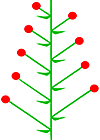
A raceme is an unbranched, indeterminate type of inflorescence bearing flowers having short floral stalks along its axis.

meadow -- Large grass and wildflower filled area with few, if any, trees.

The apex is the tip or the furthest point from the attachment.

subalpine -- Just below the timberline.

palmate -- Consisting of leaflets or lobes radiating from the base of the leaf.

orbicular -- Circular or nearly circular in outline.

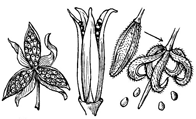
capsule -- a type of simple, dry fruit produced by many species of flowering plants. In most cases the capsule splits apart to release seeds.

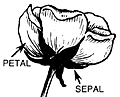
Usually green, sepals typically function as protection for the flower in bud, and often as support for the petals when in bloom.

linear -- Long and very narrow like a blade of grass.

fruit -- any seed-bearing structure in flowering plants. It is formed from the ovary after flowering.

stalk -- The supporting structure of an organ. Examples of stalks are stem, peduncle, petiole, ...

basal leaves -- a leaf that grows lowest on the stem of a plant.

genus -- A subdivision of a botanical Family in which all members have a significant number of similar characteristics.

blade -- Just the flat part of a leaf. Not the stem.

oblong -- Having an elongated form with somewhat parallel sides. Rectangular.

lobe -- Being divided by clefts.