Al Schneider's Rocky Mountains Plant Descriptions

Snowbed Whitlow-grass
Draba crassifolia
Mustard family (Brassicaceae)

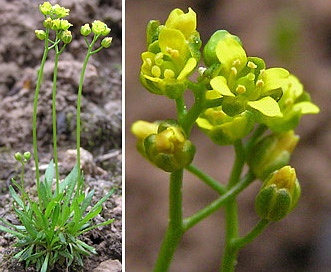
For the tiny size of this plant, its seed pods ("") are quite large -- approximately 6 millimeters long by 2 wide. The plant elongates as it flowers and mature. Often found in twos and threes, the plant can also grow in patches of hundreds. There are a number of very tiny Drabas in our area; all are a fun treat to find. Draba crassifolia is one of the more common tiny plants. We also show photos of several unusual Drabas: Draba fladnizensis, first recorded in 1778 in Fladnitz, Austria and then found many years later in the Rockies, and Draba graminea found only in the western San Juan Mountains.

The Draba was named by Linnaeus in 1753 and D. crassifolia was named by Graham in 1829 from garden plants grown from seed collected in in the 1820s by Thomas Drummond in the Canadian Rockies. "Crassifolia" is Latin for "thick-leaved," which the pictured leaves surely are not.

©2008 Al Schneider
Description

or short-lived , not ; 1 to several stems 1-5" tall, arising from a of leaves. to 2/3" long, usually , sometimes ; stem leaves lacking or as many as two very small ones. have 2 to several flowers, usually elongating in . 1/10" to 1/3" long, curved upward, . green, ; petals to 1/10" long, yellow. .

Field Marks

Minute plant with tuft of very narrow , very narrow stems, and bright yellow flowers.

© Al Schneider

ciliate -- fringed with hairs

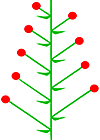
A raceme is an unbranched, indeterminate type of inflorescence bearing flowers having short floral stalks along its axis.

A perennial plant lives and blooms for many years.

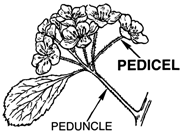
pedicel -- The stem of a single flower.

mm -- millimeter. About 1/25th of an inch.

basal leaves -- a leaf that grows lowest on the stem of a plant.

caespitose -- Grass (or plants) growing in small dense clumps or tufts.

tundra -- Land above tree line characterized by a short growing season, intense sun and wind, thin soils, very high snow fall and high rain fall. Contains low growing sedges, grasses, dwarf shrubs and herbs.

basal -- at the base, situated or attached at the base.

fruit -- any seed-bearing structure in flowering plants. It is formed from the ovary after flowering.

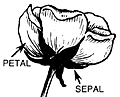
Usually green, sepals typically function as protection for the flower in bud, and often as support for the petals when in bloom.

biennial -- a plant which lives for two years, producing a basal rosette of leaves the first year and a full plant, flower, and seed the second year followed by the death of the entire plant at the end of the second year.

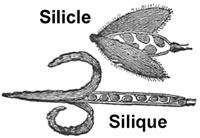
A silique is a long, thin seed capsule with the length more than 3 times the width.

genus -- A subdivision of a botanical Family in which all members have a significant number of similar characteristics.

glabrous -- smooth, glossy, having no bristles or hair-like structures. Bald.

rosette -- usually a dense cluster of leaves at the base of a plant.