Al Schneider's Rocky Mountains Plant Descriptions

Alpine Tundra Draba
Draba streptobrachia
Mustard family (Brassicaceae)

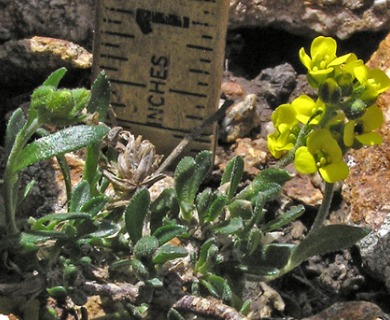
Draba streptobrachia is a rare species found only in Colorado and one mountainous New Mexico county. It enjoys the same habitat as Draba graminea and Draba crassa and it takes a careful, on the belly examination to distinguish one species from the others. All three plants are found in the thin soils of fields. Draba streptobrachia sometimes sends out brown and arched roots searching for soil. If the roots fail to find soil they still may leaf out and flower; all of the plant might then be free-swinging, just balanced on rocks or bare soil. Draba streptobrachia is an apomict, yielding abundant, well-developed seeds without fertilization. R. A. Price named this plant after some considerable controversy regarding its distinctness. It was for a time combined with Draba spectabilis. Greek gives us both "strepto" for "twisted" and "brachia" for "arms"; the name refers to the twisted arms of the hairs.

©2008 Al Schneider

Description

with a branched (woody base of non-woody ), often with leaf remains. Stems unbranched, with starburst hairs throughout. in a , to , margins , surfaces hairy. , 2-4, , to or , margins , hairy. Flower clusters with 4-10 flowers. Pods on , usually straight , hairy as stems. may be slightly twisted or flattened.

Field Marks

Tiny plant with abundance of minute yellow flowers and abundance of upright, thick, bright green leaves.

© Al Schneider

An entire leaf has smooth edges. Not toothed or lobed.

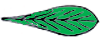
oblanceolate -- top wider than bottom

A perennial plant lives and blooms for many years.

cauline leaves -- leaves growing on a stem and especially on the upper part.

ovate -- Oval, egg-shaped, with a tapering point.

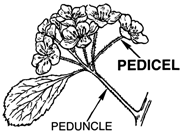
pedicel -- The stem of a single flower.

rosette -- usually a dense cluster of leaves at the base of a plant.

persistent -- When the leaves of a plant fail to fall off in the fall they are persistent. Flowers that stay around after fruiting would be persistent.

fruit -- any seed-bearing structure in flowering plants. It is formed from the ovary after flowering.

ascending -- growing obliquely upward and usually curved.

linear -- Long and very narrow like a blade of grass.

scree -- field of small, loose, slab rock. Common high on mountains.

sessile -- attached without a stalk. For example, a leaf that clasps the stalk. A petiolate leaf has a stalk.

basal leaves -- a leaf that grows lowest on the stem of a plant.

caudex -- The woody stem base of some herbaceous perennials.

oblong -- Having an elongated form with somewhat parallel sides. Rectangular.

alpine -- above the tree line. Thin soil, rocks, short growing season, frost, winter snow.