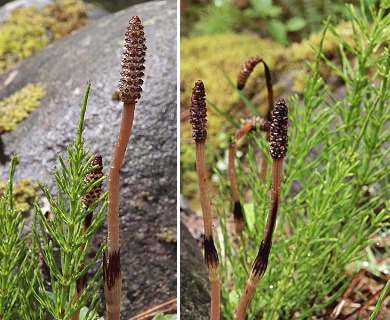
Common Horsetail Equisetum arvense Horsetails family (Equisetaceae)
The Horsetail Family is one of the most primitive. During the Carboniferous period, 300-400 million years ago, members of this family huge trees that dominated the landscape . Equisetaceae are circumboreal and are widespread through the United States. Horsetails do not bear flowers, but reproduce by or by sending up new plants from creeping . A characteristic feature of horsetails is their hollow, jointed stems. Linnaeus named this in 1753 from specimens collected in Europe. "Equisetum," is derived from the Latin "equus" for "horse" and "" for "." "Arvense" is Latin for "field."
spreading in two growth forms: sterile and fertile. The sterile stems to 24" tall are jointed, hollow and erect, supporting numerous whorls of slender branches. Leaves are -like and into . The clusters (fertile stems) are white-brown (no chlorophyll), 2-12" tall, appearing before sterile form and then withering. are branched and creeping similar to sterile stems but not hollow.
scale -- A very small leaf around a dormant bud. Also other things that
might remind one of fish scales on the surface of ferns, stems and the like.
fused means joined together.
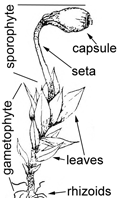
seta -- A seta is a bristle or hair-like structure.
In moss, it is the stalk supporting the capsule.
A herb is a plant whose stems die back to the ground in the winter.
spores are produced by ferns, horsetails, and other primitive plants.
Spores are like tiny seeds, but they lack food for the plant embryo.
Because spores are easily carried aloft by the wind, they allow ferns
and horsetails to reproduce asexually across considerable distances.
A perennial plant lives and blooms for many years.
bristle -- A straight, stiff hair.
included -- Enclosed and not protruding. For example, stamens within the corolla.
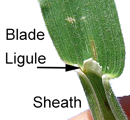
sheath -- a tubular or rolled part of an organ,
e.g. the lower part of the leaf in most grasses.
genus -- A subdivision of a botanical Family in which all members have a significant
number of similar characteristics.
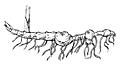
rhizome -- root-like stems that may either grow horizontally at the
soil surface or in other orientations underground.