Rough Horsetail Equisetum hyemale Horsetails family (Equisetaceae)
Like other Pteridophytes (ferns and allies), Rough Horsetail does not produce flowers or seeds. Rough Horsetail is rich in silica. Traditionally the stems were used as a natural sandpaper to scour pots and polish metal. They were also used to shape the reeds of instruments such as the saxophone and clarinet.
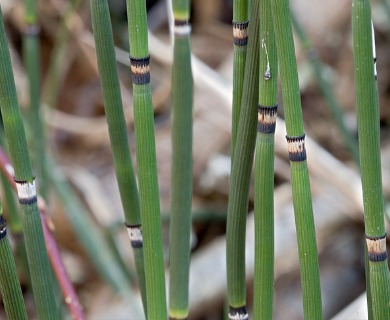
Stiff , 6-36" tall, with unbranched stems. Stems are hollow, jointed, , and rough to the touch. Leaves are reduced to small into . Two rows of on form black-green bands up the stem. Bands are shorter than they are wide. produced on short- pointed cones that are .
An evergreen tree retains a large portion of its green leaves all year.
scale -- A very small leaf around a dormant bud. Also other things that
might remind one of fish scales on the surface of ferns, stems and the like.
fused means joined together.
A perennial plant lives and blooms for many years.
A herb is a plant whose stems die back to the ground in the winter.
ribbed -- having prominent, narrow parallel protrusions that extend over most of its length or circumference.
persistent -- When the leaves of a plant fail to fall off in the fall they are persistent.
Flowers that stay around after fruiting would be persistent.
stalk -- The supporting structure of an organ. Examples of stalks are stem, peduncle, petiole, ...
spores are produced by ferns, horsetails, and other primitive plants.
Spores are like tiny seeds, but they lack food for the plant embryo.
Because spores are easily carried aloft by the wind, they allow ferns
and horsetails to reproduce asexually across considerable distances.
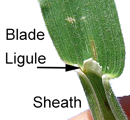
sheath -- a tubular or rolled part of an organ,
e.g. the lower part of the leaf in most grasses.