Al Schneider's Rocky Mountains Plant Descriptions

Cut-leaf Fleabane
Erigeron compositus
Aster family (Asteraceae)

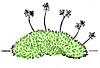
This cute Cut-leaf Fleabane is, in the words of Intermountain Flora, "a common and highly variable ... species" but it is quite distinct from other Erigerons, especially because of its deeply divided . E. compositus is primarily , i.e., it reproduces not by pollination of but by parthenogenesis (Greek for "virgin birth"). develop into new life without being fertilized. This accounts for the uniformity of characteristics in local populations. Distant populations do vary, however, especially in and ray length. Rayless forms are common. Both forms grow from two to ten inches tall. E. compositus enjoys rocky openings and can be found through most higher elevations. As is true for almost all Erigerons, the color of E. compositus varies from white to blue to pink. Frederick Pursh named this species in 1814 from a specimen collected by Meriwether Lewis in 1806 near Lewiston, Idaho.
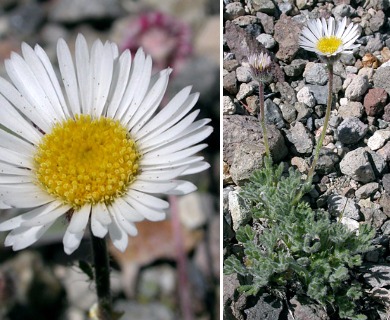

©2010 Keir Morse
Description

cushion plants with herbage and spreading hairs. Leaves mainly , mostly 2-3 times ternately or dissected, from 1/5 to 3" long. few and reduced in size upward on the plant, or . Stems from 1 to 8" tall. Heads solitary. from 1/3 to 1" wide and 1/5 to nearly 1/2" high, the and spreading-hairy, commonly purple at the tips. Rays lacking or present 20-60, blue, pink or white to 1/2" long and less than 1/10" wide. simple. an , 2-, hairy.

Field Marks

Hairy, finely cut topped by short stems and a single one inch flower.

© Al Schneider

nerves -- Another name for a vein.

apomixis -- A type of asexual reproduction whereby viable seeds or spores are produced asexually, without fertilization.

A perennial plant lives and blooms for many years.

cauline leaves -- leaves growing on a stem and especially on the upper part.

achene -- a type of simple dry fruit produced by many species of flowering plants. For example, a rose hip holds a few achenes.

pubescent -- downy; covered with short, soft, erect hairs.

caespitose -- Grass (or plants) growing in small dense clumps or tufts.

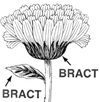
Bracts are modified leaves associated with a flower.

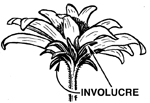
Involucre is the name given to the circle or spiral collection of bracts around a flower-cluster.

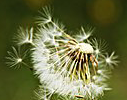
pappus -- Small scales, bristles or hairs at the top of the seed in Asteraceae. For example, dandelion parachutes. Plural: pappi.

basal -- at the base, situated or attached at the base.

Glands are plant structures that secrete liquids, salts or other substances. Glands often appear as hairs with a drop of liquid at the end.

fruit -- any seed-bearing structure in flowering plants. It is formed from the ovary after flowering.

basal leaves -- a leaf that grows lowest on the stem of a plant.

ternate -- Leaves in groups of three. Whorls of three. Three leaflets.

ovules -- the part of the ovary of seed plants that contains the female germ cell. After fertilization an ovule becomes the seed.

A simple leaf blade is one that is not divided into separate leaflets.

lobe -- Being divided by clefts.