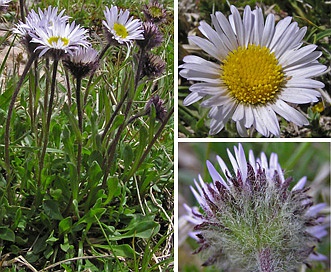
Large-flower Fleabane Erigeron grandiflorus Aster family (Asteraceae)
Colorado plant authority William Weber indicates that this dainty plant of the is "uncommon or rare on " in Colorado, but it is considered fairly common on Colorado by John Kartesz in his "Synthesis" and the "Flora of North America" considers it fairly common in the Rockies. It appears that the disagreement is over splitting and lumping. Weber considers this species distinct from the much more common Erigeron simplex. The "Synthesis" and the "FNA" combine the two species into one, E. grandiflorus. Interestingly (or maddeningly) "Intermountain Flora" and "Utah Flora" also combine the two species but into E. simplex! Split or lump, the plant is still lovely, grows only on , is often minute, and is certainly a treat to find. Erigeron grandiflorus was named by William Jackson Hooker in 1834 in his "Flora Boreali-Americana".
from 1 to 10" tall, . Stems usually erect, sparsely to moderately hairy and often over all or part of the stem. ; with equal to or shorter than the which are to or 2/5 to 3" long by 1/8 to 1/3" wide; abruptly or gradually smaller up the stem, margins , hairy or . in 2-3 overlapping rows, green or purple, hairy. , 7-11, blue to pink to purple, rarely white. a 2- .
ray flowers -- The outer petals of a sunflower or daisy are ray flowers.
An entire leaf has smooth edges. Not toothed or lobed.
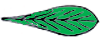
oblanceolate -- top wider than bottom
A perennial plant lives and blooms for many years.
cauline leaves -- leaves growing on a stem and especially on the upper part.
achene -- a type of simple dry fruit produced by many species of flowering plants.
For example, a rose hip holds a few achenes.
A herb is a plant whose stems die back to the ground in the winter.
phyllaries -- Leaflike bracts covering the flowers before opening and remaining under the
flower after it opens. Also called "bracts". Only used with the sunflower family (Asteraceae).
obovate -- Teardrop-shaped, stem attaches to tapering point.
persistent -- When the leaves of a plant fail to fall off in the fall they are persistent.
Flowers that stay around after fruiting would be persistent.
tundra -- Land above tree line characterized by a short growing season, intense sun
and wind, thin soils, very high snow fall and high rain fall. Contains low
growing sedges, grasses, dwarf shrubs and herbs.
Glands are plant structures that secrete liquids, salts or other substances.
Glands often appear as hairs with a drop of liquid at the end.
fruit -- any seed-bearing structure in flowering plants.
It is formed from the ovary after flowering.
spatulate -- spoon-shaped.
basal leaves -- a leaf that grows lowest on the stem of a plant.
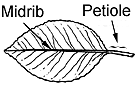
petiole -- the stalk of a leaf.
blade -- Just the flat part of a leaf. Not the stem.
glabrous -- smooth, glossy, having no bristles or hair-like structures. Bald.
nerves -- Another name for a vein.
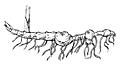
rhizome -- root-like stems that may either grow horizontally at the
soil surface or in other orientations underground.