Blackhead Fleabane Erigeron melanocephalus Aster family (Asteraceae)
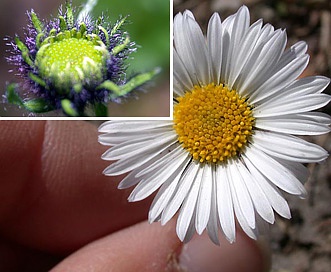
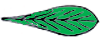
Black hairs on the green (look under the white ), spoon-shaped leaves, and a large, showy flower identify this very small and common high altitude Erigeron. Several short, often twisting leaves are common high on the flower . Plants can be six inches tall but they are commonly just two inches. Many dozens of plants often dot and with their brilliant white flowers. Aven Nelson first collected this plant in the Medicine Bow Mountains of Wyoming; he named and described it in 1896. "Melanocephalus" is Greek for "black head."
, from a simple or branched (woody base of non-woody ), branches clothed with dark leaf bases. Herbage hairy. Stems 2 to 6" tall, erect. from 1/3 to 2" long, to , rounded at the tips. much reduced upward on the stem. Flowerheads solitary with about 1/2" wide and 1/3" high, the most often densely black hairy, same length, green with purple tips or purple throughout. 50-70, white, about 1/3" long. single of about 22 . a 2- .
cauline leaves -- leaves growing on a stem and especially on the upper part.
oblanceolate -- top wider than bottom
meadow -- Large grass and wildflower filled area with few, if any, trees.
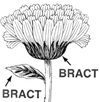
phyllaries -- Leaflike bracts covering the flowers before opening and remaining under the
flower after it opens. Also called "bracts". Only used with the sunflower family (Asteraceae).
achene -- a type of simple dry fruit produced by many species of flowering plants.
For example, a rose hip holds a few achenes.
A herb is a plant whose stems die back to the ground in the winter.
subalpine -- Just below the timberline.
ray flowers -- The outer petals of a sunflower or daisy are ray flowers.
Bracts are modified leaves associated with a flower.
spatulate -- spoon-shaped.
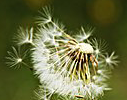
pappus -- Small scales, bristles or hairs at the top of the seed in Asteraceae. For example,
dandelion parachutes. Plural: pappi.
basal -- at the base, situated or attached at the base.
fruit -- any seed-bearing structure in flowering plants.
It is formed from the ovary after flowering.
A perennial plant lives and blooms for many years.
stalk -- The supporting structure of an organ. Examples of stalks are stem, peduncle, petiole, ...
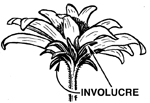
Involucre is the name given to the circle or spiral collection
of bracts around a flower-cluster.
bristle -- A straight, stiff hair.
basal leaves -- a leaf that grows lowest on the stem of a plant.
caudex -- The woody stem base of some herbaceous perennials.
nerves -- Another name for a vein.
alpine -- above the tree line. Thin soil, rocks, short growing season, frost, winter snow.