Al Schneider's Rocky Mountains Plant Descriptions

Western Wallflower
Erysimum capitatum
Mustard family (Brassicaceae)

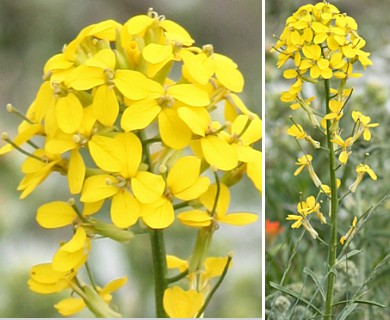
Wallflower (Erysimum capitatum) is a handsome plant often brightening the dry-brown duff under high desert Junipers and Pinyons in the early spring and continuing to bloom in June and July habitats and from July to September in sub- and settings. Western Wallflower is extremely variable in appearance. Erysimum asperum is very similar to Erysimum capitatum and some botanists consider them the same species. Flowers of Erysimum capitatum are attractive to a number of butterfly species, making it a common garden plant.

Linnaeus named this in 1753. "Erysimum," from the Greek "eryomai" meaning "help" or "save," refers to the centuries old belief that the plant had medicinal properties. David Douglas collected the first specimens of this plant in "rocky places of the Columbia, near the sea; and at Puget Sound." "Capitatum" (Latin for "head," as in "decapitate') refers to the rounded, head-shaped flower cluster.

©2008 Walter Siegmund

Description

Single-stemmed (occasionally branched) or short-lived , 8-30" tall, with showy typically yellow (but may be orange or lavender) flowers in dense rounded cluster. Individual flowers have 4 petals and pouch-shaped outer . are -elliptical with to sharply margins. Stem leaves are and with overall gray-green appearance. Seed pods are 4-sided, quite thin, up to 4" long, and grow outward and upward, often parallel to stem.

Field Marks

Narrow, bright green horizontal leaves. Round yellow flowerhead with 4-petaled flowers.

© Al Schneider

An entire leaf has smooth edges. Not toothed or lobed.

A perennial plant lives and blooms for many years.

A herb is a plant whose stems die back to the ground in the winter.

basal leaves -- a leaf that grows lowest on the stem of a plant.

Like the teeth on a saw, leaves and other surfaces can have toothed edges.

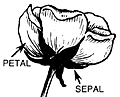
Usually green, sepals typically function as protection for the flower in bud, and often as support for the petals when in bloom.

terminal -- Located at the end (the tip or the apex).

linear -- Long and very narrow like a blade of grass.

biennial -- a plant which lives for two years, producing a basal rosette of leaves the first year and a full plant, flower, and seed the second year followed by the death of the entire plant at the end of the second year.

montane -- inhabiting mountainous country but below timberline.

genus -- A subdivision of a botanical Family in which all members have a significant number of similar characteristics.

alternate -- leaves alternate along the main stem and are attached singly.

alpine -- above the tree line. Thin soil, rocks, short growing season, frost, winter snow.