Al Schneider's Rocky Mountains Plant Descriptions

Tiling's Monkeyflower
Erythranthe tilingii
Monkey-Flower family (Phrymaceae)

Monkey flowers are common at many altitudes along and in streams. They are an eye-catching very bright yellow. Watch for them whenever a small rivulet crosses your trail in the mountains. The plant's sap can be used to heal wounds as it has agents effective in contracting human tissue.

Erythranthe tilingii and a sister species, Erythranthe guttata, are easily confused. Use the following criteria to distinguish Erythranthe tilingii : 1) typically found at and altitudes; 2) 10" or shorter versus Erythranthe guttata to 20" tall; 3) 1-5 flowers per stem versus often more than 5 for Erythranthe guttata 4) spreads by in tight masses versus -forming for Erythranthe guttata.
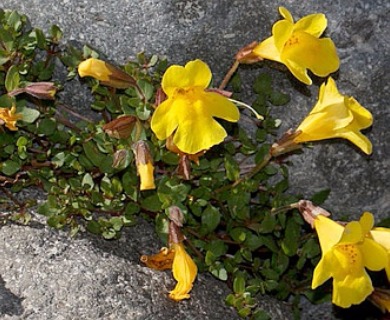

©2010 Walter Siegmund

Eduard Regel named this species in 1869 from specimens he grew from seeds sent him by S. H. Tiling, Russian botanist who collected the seeds in Nevada City, California in 1868.

Description

, 2-10" tall, with yellow flowers comprised of petals forming a tube with 2 upper and 3 lower . Lower lip of flower has maroon spots and hairy . green or yellow is ridged and with upper tooth being the longest. Hollow stems support egg-shaped opposite leaves that have a few sharp on the margins.

Field Marks

Bright yellow snap-dragon-like flowers, 1-3 per stem, growing in wet seeps at high altitudes.

© Al Schneider

fused means joined together.

A perennial plant lives and blooms for many years.

lobe -- A rounded parts of a leaf (or other organ).

A herb is a plant whose stems die back to the ground in the winter.

subalpine -- Just below the timberline.

throat -- The opening of a flower.

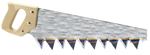
Like the teeth on a saw, leaves and other surfaces can have toothed edges.

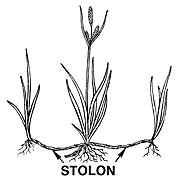
stolon -- A slender modified stem running along the ground, rooting at the tip, and sprouting new plants. Strawberries have stolons. Also called runners.

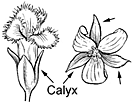
calyx -- the sepals of a flower, typically forming a whorl that encloses the petals and forms a protective layer around a flower in bud.

alpine -- above the tree line. Thin soil, rocks, short growing season, frost, winter snow.

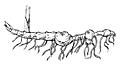
rhizome -- root-like stems that may either grow horizontally at the soil surface or in other orientations underground.