Al Schneider's Rocky Mountains Plant Descriptions

Glacier Lily
Erythronium grandiflorum
Lily family (Liliaceae)

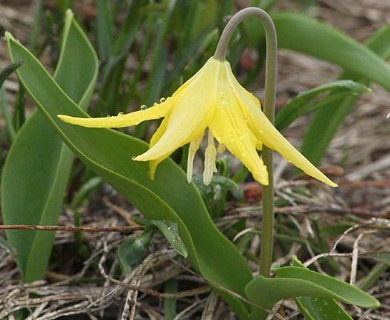
As the winter snows recede, Glacier Lilies are one of the first flowers to bloom. They are often found in large showy colonies of bright yellow. This is one of several lilies commonly called "Dogtooth Lily" or "Dogtooth Violet." Their underground stems are a favorite of bears and other critters. "Erythro" is Greek for "red" and may refer to the color of some species (not in our area) or to the more often found red . Meriwether Lewis collected the first specimen of this plant for science in present-day Idaho near the Clearwater River in 1806.

©2008 Walter Siegmund
Description

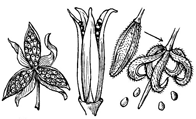
rising to 15" from -like . Single bright yellow, deeply nodding flower atop each stem. Six are curved backward and 6 prominent project downward. A single pair of parallel-veined leaves, 4-8" long, emerge from base of the stem. are erect 3-sided , club-shaped, with dark brown seeds.

Field Marks

Bright yellow nodding flower with curved , 1 pair .

© Al Schneider

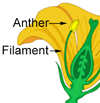
stamen -- the pollen-producing reproductive organ of a flower; The stamen consists of an anther supported by a filament.

A perennial plant lives and blooms for many years.

A herb is a plant whose stems die back to the ground in the winter.

basal leaves -- a leaf that grows lowest on the stem of a plant.

corm -- a short, thick, fleshy underground stem which sends off roots from its lower face.

capsule -- a type of simple, dry fruit produced by many species of flowering plants. In most cases the capsule splits apart to release seeds.

fruit -- any seed-bearing structure in flowering plants. It is formed from the ovary after flowering.

The anther is a pad at the end of the stamen that holds the pollen.

A bulb is an underground stem, the main body of which consists of thickened scales, which are in reality leaves or leaf bases, as in the onion.

tepal -- like a flower petal. Tepal is used, instead of petal, when it is not easy to tell the sepals from the petals.