Al Schneider's Rocky Mountains Plant Descriptions

Woodland Spurge
Euphorbia lurida
Spurge family (Euphorbiaceae)

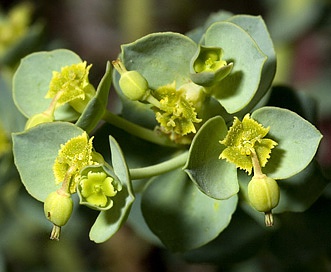
Woodland Spurge grows in a tangled mass up to several feet wide and over a foot tall in moist areas or it may be spindly and solitary in dry conditions. It has a wide range, from moist sandy areas to dry Pinyon-Juniper forests to Ponderosa and low spruce forests. What appears to be a flower is instead a , a cup-like structure that houses a central surrounded by several . The yellow horned structures are not true petals but merely extensions of the . When fertilized, the central elongates, swells, and hangs out of the .

In 1753 Linnaeus named the "Euphorbia," most probably for Euphorbus, a physician of a king in an ancient kingdom of North Africa. "Euphorbia" is also the classical name of a related North African species. This plant was first collected for science by Charles Wright in 1821 in Texas.

©2009 Patrick Alexander

Description

from a stout , a woody base on an otherwise non-woody . The is and . Stems to 18" tall, erect, usually numerous. , 1/3 to 1" long and about the same width, to or , , the lower ones often just . Plant has a simulating a single flower and often with petal-like appendages. has two branches and a large leaf-like subtends the branching. Male and female flowers on same plant. a .

Field Marks

Sprawling gangly plant with curiously shaped, fascinating, reproductive structures.

© Al Schneider

An entire leaf has smooth edges. Not toothed or lobed.

A perennial plant lives and blooms for many years.

An inflorescence is a group or cluster of flowers arranged on a stem.

The false flower of plants in the spurge family is called a cyathium. It consists of a cup-shaped structure that holds nectar glands, one reduced female flower in the center of the base and five groups of extremely reduced male flowers. The nectar glands might be mistaken for petals.

A herb is a plant whose stems die back to the ground in the winter.

orbicular -- Circular or nearly circular in outline.

pistillate -- a flower that lacks stamens is pistillate, or female. One that lacks pistils is said to be staminate, or male.

spatulate -- spoon-shaped.

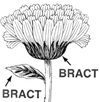
Bracts are modified leaves associated with a flower.

glaucous -- Pale gray or bluish-green. It can mean covered with a greyish, bluish or whitish coating.

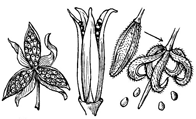
capsule -- a type of simple, dry fruit produced by many species of flowering plants. In most cases the capsule splits apart to release seeds.

fruit -- any seed-bearing structure in flowering plants. It is formed from the ovary after flowering.

oblong -- Having an elongated form with somewhat parallel sides. Rectangular.

caudex -- The woody stem base of some herbaceous perennials.

genus -- A subdivision of a botanical Family in which all members have a significant number of similar characteristics.

glabrous -- smooth, glossy, having no bristles or hair-like structures. Bald.

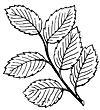
leaves alternate along the main stem and are attached singly.

staminate flowers -- Having only male, pollen producing floral parts.