Virginia Strawberry Fragaria virginiana Rose family (Rosaceae)
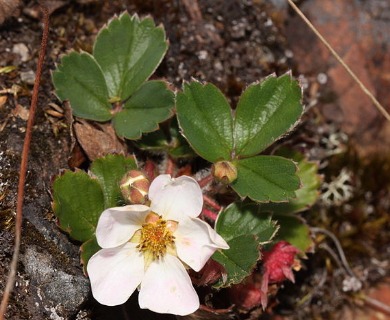
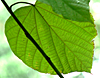
Wild Strawberry (Fragaria virginiana) is a very common ground-hugging plant with prominent leaves, conspicuous flowers, and incredibly sweet, tiny red . The are, unfortunately, so treasured by wild critters that we humans get only a few. F. virginiana sends out red to reproduce itself and is thus found in patches (often large). It blooms from early spring until frost in low , open woods, hot barren slopes, and high areas. Its leaves turn lovely shades of reds and maroons in the fall. This species is very similar to F. vesca differing primarily in several ways: it prefers moister sites; has green vs. blue-green leaves; its leaves are more deeply with deeper more obvious ; and seeds are on the surface vs. imbedded.
"Virginiana" is a common specific epithet given either because the plant was first collected in Virginia or to honor that colony/state. (The same is true of such names as "Canadensis," "Missouriensis," "Arizonica"....) Linnaeus named this in 1753, giving it the classical Latin name for the strawberry plant. In 1768 Phillip Miller named Fragaria virginiana.
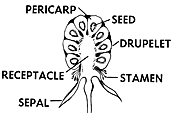
, ; stems, , and with to hairs. from 1 to 5" long. 3, the one from 1/2 to 1 1/2" long and up to almost an inch wide, to , coarsely , to . Flower clusters 2 to 12-flowered. Petals 1/7 to almost 1/2" long, white. are on a red fleshy , a strawberry.
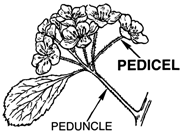
A peduncle is a common stalk of a cluster of flowers.
meadow -- Large grass and wildflower filled area with few, if any, trees.
achene -- a type of simple dry fruit produced by many species of flowering plants.
For example, a rose hip holds a few achenes.
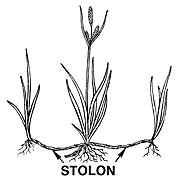
stolon -- A slender modified stem running along the ground, rooting at the tip,
and sprouting new plants. Strawberries have stolons. Also called runners.
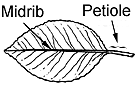
petiole -- the stalk of a leaf.
The receptacle is the thickened part of a stem (pedicel) from which
the flower organs grow.
silky -- Covered with fine soft hairs, with a lustrous sheen. Satiny to the touch.
venation -- The arrangemnet of veins in a leaf.
serrate -- toothed with asymmetrical teeth pointing forward; like the cutting edge of a saw.
terminal -- Located at the end (the tip or the apex).
stoloniferous -- Having stolons or runners, stems running along the ground.
elliptic -- Oval, with no point or a very short point.
obovate -- Teardrop-shaped, stem attaches to tapering point.
glabrate -- Almost smooth and glossy or becoming smooth and glossy with age.
A herb is a plant whose stems die back to the ground in the winter.
subalpine -- Just below the timberline.
ascending -- growing obliquely upward and usually curved.
fruit -- any seed-bearing structure in flowering plants.
It is formed from the ovary after flowering.
appressed -- pressed close or flat against another surface as in hairs appressed against a stem.
leaflets -- Each little leaf-like thing in a compound leaf is a leaflet.
A perennial plant lives and blooms for many years.
The botanical term "berry" is different from common usage. Strawberries and raspberries are not berries.
But a tomatoe is. A true berry is a fruit with the seeds immersed in the pulp.
plumose -- Feathery, i.e., having hairs or fine bristle on both sides of the main axis.
Often used in describing the shape of pappus hairs.
genus -- A subdivision of a botanical Family in which all members have a significant
number of similar characteristics.