Al Schneider's Rocky Mountains Plant Descriptions

Monument Plant
Frasera speciosa
Gentian family (Gentianaceae)

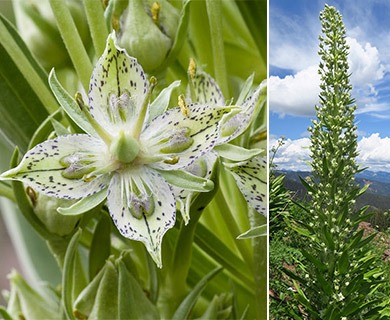
Green Gentian grows for 20-60 years. The plant then develops a 4-7 foot bearing 600 flowers that produce 60 seeds each to give rise to the next generation. The dried persists through winter. Plants with life cycles such as this are called "," i.e., growing for many years without flowering and then flowering and immediately dying after the seeds develop. Green Gentian was first collected for science by David Douglas (of Douglas Fir fame) in the present-day Spokane area in the early 1830s. The name, "Frasera," is for John Fraser, 18th century nurseryman and botanist. "Speciosa" ("showy") is for the leaves and massive display of flowers.

©2010 Barry Rice, ©2019 Adam Schneider
Description

with huge to several feet high and wide and single flower to 7' tall. Leaves hairy to , ones to 2' long and 4" wide, or - to ; much reduced in size upward, to . crowded. , to 1'" long. pale green to white with purple dots, the to 1" long, with 2 on each , margins fringed. a to 1" long.

Field Marks

Large whorl of upright , eventually tall flower with white/green flowers with purple dots.

© Al Schneider

Glands are plant structures that secrete liquids, salts or other substances. Glands often appear as hairs with a drop of liquid at the end.

A monocarpic plant is one that dies after flowering, although it may take several years to flower. The Century Plant is monocarpic.

glabrous -- smooth, glossy, having no bristles or hair-like structures. Bald.

lanceolate -- Lance-shaped. Long, wider in the middle.

rosette -- usually a dense cluster of leaves at the base of a plant.

cauline leaves -- leaves growing on a stem and especially on the upper part.

elliptic -- Oval, with no point or a very short point.

basal leaves -- a leaf that grows lowest on the stem of a plant.

oblong -- Having an elongated form with somewhat parallel sides. Rectangular.

oblanceolate -- top wider than bottom

lobe -- A rounded parts of a leaf (or other organ).

A herb is a plant whose stems die back to the ground in the winter.

spatulate -- spoon-shaped.

basal -- at the base, situated or attached at the base.

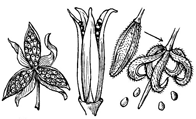
capsule -- a type of simple, dry fruit produced by many species of flowering plants. In most cases the capsule splits apart to release seeds.

fruit -- any seed-bearing structure in flowering plants. It is formed from the ovary after flowering.

An inflorescence is a group or cluster of flowers arranged on a stem.

A perennial plant lives and blooms for many years.

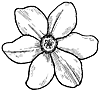
corolla -- The name for all the petals of a flower taken together.

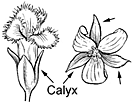
calyx -- the sepals of a flower, typically forming a whorl that encloses the petals and forms a protective layer around a flower in bud.

stalk -- The supporting structure of an organ. Examples of stalks are stem, peduncle, petiole, ...

genus -- A subdivision of a botanical Family in which all members have a significant number of similar characteristics.