Broom Snakeweed
Gutierrezia sarothrae
Aster family (Asteraceae)
This is a very common plant throughout the intermountain West. In late summer and early fall Broom Snakeweed turns fields golden with hundreds of plants and tens of thousands of flowers. The plant is so common, and multiplies unchecked on grazed land because it is poisonous to livestock. High water use efficiency, a high degree of drought tolerance, and a highly variable growth habit enable Broom Snakeweed to survive on arid or semi-arid sites and to respond to differences in soils. It can vary itself from a small shrublet to a very hardy shrub over three feet high and several feet wide. Gutierrezia microcephala and Gutierrezia sarothrae are quite similar and one needs a bit of determination and a hand lens to distinguish between the two. The most easily observed difference is in the flowers: G. microcephala has 1 or 2 and 1-3 flowers; G. sarothrae has 3-7 and 3-8 flowers.
From a specimen collected by Sesse and Mocino on their 1787-1803 Spanish Royal Expedition to New Spain, Mariano Lagasca, Director of the Real Jardin Botanico de Madrid, named a new : "Gutierrezia." Exactly who he was honoring with this name is now unknown. "Sarothrae" is from the Greek for "broom."
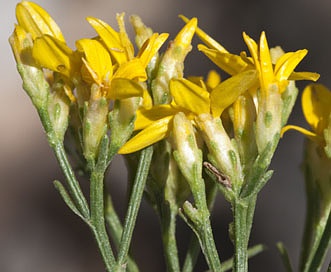
©2012 Richard Spellenberg