Al Schneider's Rocky Mountains Plant Descriptions

Little-leaf Alumroot
Heuchera parvifolia
Saxifrage family (Saxifragaceae)

These common, dainty white-to-yellow summer flowers are cousins of the garden "Red Coral Bells." They especially enjoy rocky areas and are often found there in colonies of several to a dozen or more plants. Their scalloped, thick, bright green leaves and tall swaying stalks make them easy to spot even from a distance. The name was given by Linnaeus in 1753 for the German botanist J. H. Heucher. The specific epithet means "small leaf" and was, in 1840, given by Nuttall who was the first to collect this plant for science in his 1834-1837 trip to the Pacific with the Wyeth Expedition.
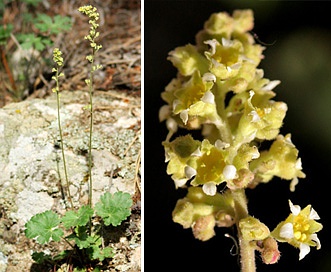

©2005 Patrick Alexander
Description

plants with scaly rootstocks, stems , , flowering stem to over 18" tall, with conspicuous white hairs. long and usually . Leaf 1-2" across, gently 5-9 times, upper surface , lower usually , margins . to almost 10" long, very narrow at first and then widening. Flowers very small, green to yellow. Petals usually exceeding the . , minute. from 1/8 to 1/3" long, or .

Field Marks

Tiny yellow-white flowers in a tall swaying flower above scalloped .

© Al Schneider

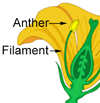
stamen -- the pollen-producing reproductive organ of a flower; The stamen consists of an anther supported by a filament.

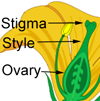
style -- This is a long and thread-like structure that connects the stigma with the ovary. A flower may have a single style, or several of them.

A perennial plant lives and blooms for many years.

ellipsoid -- Shaped like a watermellon. Smaller.

A herb is a plant whose stems die back to the ground in the winter.

scape -- a long, leafless flower stalk coming directly from a root. The tulip has a scape.

An inflorescence is a group or cluster of flowers arranged on a stem.

ciliate -- fringed with hairs

Glands are plant structures that secrete liquids, salts or other substances. Glands often appear as hairs with a drop of liquid at the end.

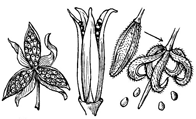
capsule -- a type of simple, dry fruit produced by many species of flowering plants. In most cases the capsule splits apart to release seeds.

stalk -- The supporting structure of an organ. Examples of stalks are stem, peduncle, petiole, ...

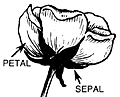
Usually green, sepals typically function as protection for the flower in bud, and often as support for the petals when in bloom.

basal leaves -- a leaf that grows lowest on the stem of a plant.

included -- Enclosed and not protruding. For example, stamens within the corolla.

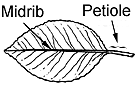
petiole -- the stalk of a leaf.

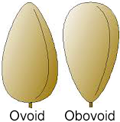
ovoid -- egg-shaped, with the wider portion at the base.

genus -- A subdivision of a botanical Family in which all members have a significant number of similar characteristics.

blade -- Just the flat part of a leaf. Not the stem.

glabrous -- smooth, glossy, having no bristles or hair-like structures. Bald.

lobe -- Being divided by clefts.