Al Schneider's Rocky Mountains Plant Descriptions

Graylocks Four-nerve Daisy
Hymenoxys grandiflora
Aster family (Asteraceae)

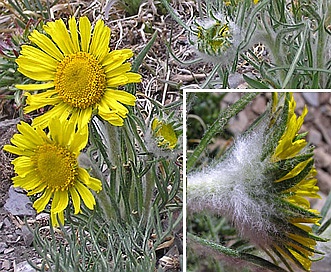
With flowers so large they often obscure the stems and leaves, Old Man of the Mountain cannot be missed -- unless you don't hike above tree-line. On the open , this plant is abundant and very obvious. Flower stalks range from just a few inches tall to twelve inches tall. Old Man of the Mountain is often abundant on and it is a treat to see its huge sunflowers, most of which always face east. The stems and leaves of Old Man are a distinctive very densely hairy green. Research over the past few decades by Dr. David Inouye with the Rocky Mountain Biological Institute in Gothic Colorado, indicates that Hymenoxys grandiflora grows for 12-15 years without flowering. Once it does flower, it dies.

Hymenoxys grandiflora was first collected for science by John Fremont in the early 1840s in the Wind River Mountains of Wyoming and it was named Actinella by Torrey and Gray in 1845. In 1898 Edward Greene named it Rydbergia grandiflora, and in 1980 K. L. Parker named it Hymenoxys grandiflora.

©2004 Al Schneider
Description

Stout, low-growing () with a fleshy . Stems to 12" tall, 1 to several, simple or usually branched below, densely hairy. and , 1 to 5" long, 2-3 ternately or even divided into 2-30 segments. Heads solitary, quite large, commonly 1 1/2" across. from 1/5 to 1 1/2" high. numerous in 2-3 rows, about 1/2" long, densely wooly. 19-54, 1"+ long with 8-12 veins. 5-8, about 1/5" long. an .

Field Marks

Very silvery hairy sunflower with very large and showy flowerheads, horizontal and almost always facing east.

© Al Schneider

cauline -- Leaves that are on the stem. Not basal.

ray flowers -- The outer petals of a sunflower or daisy are ray flowers.

grandiflora -- Large-flowered.

A monocarpic plant is one that dies after flowering, although it may take several years to flower. The Century Plant is monocarpic.

fruit -- any seed-bearing structure in flowering plants. It is formed from the ovary after flowering.

corolla -- The name for all the petals of a flower taken together.

palmate -- Consisting of leaflets or lobes radiating from the base of the leaf.

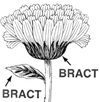
Bracts are modified leaves associated with a flower.

tundra -- Land above tree line characterized by a short growing season, intense sun and wind, thin soils, very high snow fall and high rain fall. Contains low growing sedges, grasses, dwarf shrubs and herbs.

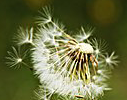
pappus -- Small scales, bristles or hairs at the top of the seed in Asteraceae. For example, dandelion parachutes. Plural: pappi.

taproot -- The primary decending root of a plant.

achene -- a type of simple dry fruit produced by many species of flowering plants. For example, a rose hip holds a few achenes.

linear -- Long and very narrow like a blade of grass.

scale -- A very small leaf around a dormant bud. Also other things that might remind one of fish scales on the surface of ferns, stems and the like.

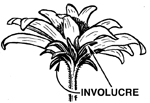
Involucre is the name given to the circle or spiral collection of bracts around a flower-cluster.

basal leaves -- a leaf that grows lowest on the stem of a plant.

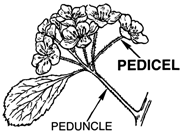
A peduncle is a common stalk of a cluster of flowers.

alpine -- above the tree line. Thin soil, rocks, short growing season, frost, winter snow.

A perennial plant lives and blooms for many years.