Al Schneider's Rocky Mountains Plant Descriptions

Rocky Mountain Iris
Iris missouriensis
Iris family (Iridaceae)

Seeing Iris in a mountain startles those unaccustomed to wildflowers, for they think of Iris as a domesticated garden flower. The domestic comes from the wild. The plant can be so abundant that actually appear from a distance to be ponds. Roasted seeds can be used as a coffee substitute. Roots and young shoots are toxic, though roots have been used medicinally to treat toothache. Linnaeus named this in 1753 and the species was named by Thomas Nuttall in 1834 from a specimen collected by his friend Nathaniel Wyeth "towards the sources of the Missouri." "Iris" was the Greek goddess of the rainbow and "missouriensis" refers to the river.
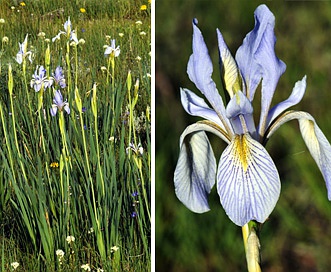

©2008 James L. Reveal
Description

Erect , 8-24" tall, with pale to dark lavender-blue flowers that domesticated Iris resemble. Tall stems with 2 or more long, narrow, parallel-veined . Each stem bears 2-4 flowers. Three petal-like are bent backward with purple veins and yellow center stripes.

Field Marks

Large, flared, usually light blue showy petals and long, thin, nearly vertical leaves.

© Al Schneider

meadow -- Large grass and wildflower filled area with few, if any, trees.

A herb is a plant whose stems die back to the ground in the winter.

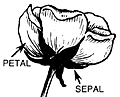
Usually green, sepals typically function as protection for the flower in bud, and often as support for the petals when in bloom.

basal leaves -- a leaf that grows lowest on the stem of a plant.

genus -- A subdivision of a botanical Family in which all members have a significant number of similar characteristics.

A perennial plant lives and blooms for many years.