Al Schneider's Rocky Mountains Plant Descriptions

Common Juniper
Juniperus communis
Cypress family (Cupressaceae)

Considered the most widespread conifer in the world, Common Juniper is native to temperate Eurasia and North America. It is abundant in North America beyond the northern limit of trees, occurring from western Alaska and British Columbia to Newfoundland. Junipers occupy an extraordinary range of habitats. Common Juniper's extensive range brings it more than 150 common names including Dwarf Juniper, Juniper, and Ground Juniper. Seed cones are used to flavor gin. In his "Species Plantarum" of 1753, Linnaeus named both the Juniperus and this species.
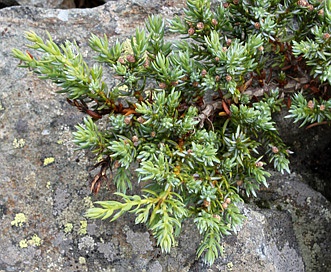

©2014 Steve Sullivan

Description

coniferous shrub, 1-4' tall with trunks several or solitary, low, spreading, and often forming mats. Needles mostly in whorls of 3, stiff and very sharp, white above and green below. Male and female cones on different plants (). Female seed cones mature the second season into blue-black cones (that look like ) often fleshy and waxy-coated. Male cones small, solitary, round to egg-shaped.

Field Marks

shrub, often mat-forming, stiff sharp needles in whorls of 3.

© Al Schneider

An evergreen tree retains a large portion of its green leaves all year.

The botanical term "berry" is different from common usage. Strawberries and raspberries are not berries. But a tomatoe is. A true berry is a fruit with the seeds immersed in the pulp.

prostrate -- Laying flat on the ground.

dioecious -- When male and female reproductive structures are on separate plants.

genus -- A subdivision of a botanical Family in which all members have a significant number of similar characteristics.