Al Schneider's Rocky Mountains Plant Descriptions

Common Duckweed
Lemna minor
Arum/Calla-Lily family (Araceae)

Lemna tissue contains twice the protein, fat, nitrogen, and phosphorus of other vascular plants and absorb nutrients through the whole plant, not through the root system. The plant is rich food for fish and birds and the latter disperse the plant to new sites, especially when the sticky roots adhere to the bird. The plant is very successful at reproduction and often has to be cut back when used in aquaria. "Lemna" is from the Greek for "water plant" or "star grass." "Minor" is from the Latin for "lesser."
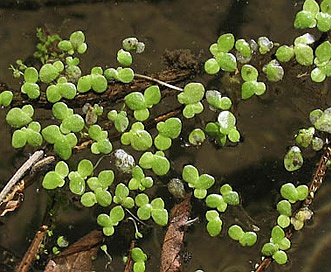

©2010 Anthony Valois and the National Park Service
Description

Diminutive floating aquatic , often forming a solid cover on the water surface. Leaves and stems are merged into a single structure (called a "") made up of several layers of obvious air spaces and veins. The is flattened, nearly , and smooth. Flowers are uncommon but when present consist of 2 and a single in a sack. The plant propagates mainly by division.

Field Marks

Floating masses of tiny green plants, rarely with flowers.

© Al Schneider

frond -- a large, divided leaf. The leaves of most ferns are fronds.

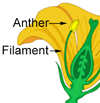
stamen -- the pollen-producing reproductive organ of a flower; The stamen consists of an anther supported by a filament.

orbicular -- Circular or nearly circular in outline.

A perennial plant lives and blooms for many years.

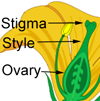
A pistil is the female structure of many flowers. It contains one or more carpels. Each carpel contins an ovary, style and stigma. The stigma receives the pollen which grows thru the style to reach the ovary.